AI in the Workplace 2026: How Artificial Intelligence Is Reshaping Jobs

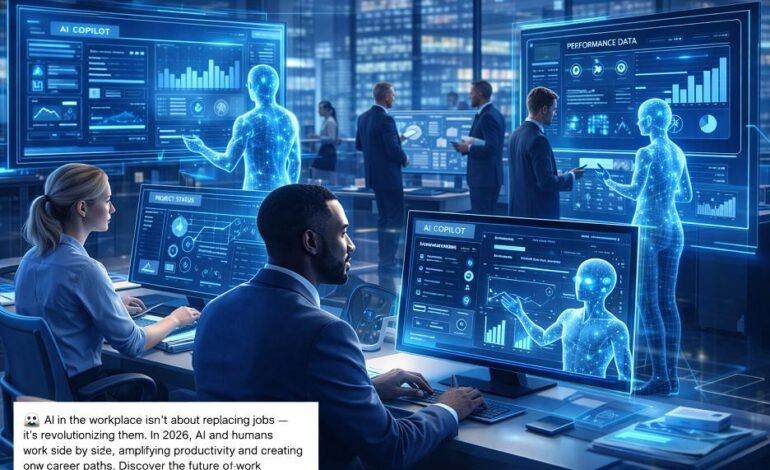
Artificial intelligence is no longer a future disruption — it’s an active workforce participant.
In 2026, AI tools powered by companies like OpenAI, Microsoft, and Google are embedded into daily workflows across industries.
From automating repetitive tasks to assisting in strategic decision-making, AI in the workplace is transforming how we work — and redefining what jobs look like.
How AI Is Changing the Nature of Work
AI is shifting work in three major ways:
1. Automation of Repetitive Tasks
Administrative work, data entry, report generation, scheduling, and customer queries are increasingly handled by AI productivity tools.
Result: Employees focus more on creative and strategic tasks.
2. Augmentation, Not Just Replacement
Rather than fully replacing workers, AI often enhances human capabilities.
Examples:
-
Lawyers using AI for legal research.
-
Marketers using AI for campaign optimization
-
Developers using AI coding assistants
-
HR teams using AI for resume screening
This human + AI collaboration model is becoming the dominant structure.
3. Emergence of New Roles
AI is also creating entirely new job categories:
-
AI Prompt Engineers
-
AI Governance Specialists
-
Machine Learning Operations (MLOps) Engineers
-
AI Ethics Consultants
-
AI Trainers & Data Annotators
The workforce isn’t shrinking — it’s evolving.
Industries Most Impacted by AI Job Automation
1. Technology & Software Development
AI-assisted coding tools accelerate development cycles and reduce debugging time.
2. Finance & Accounting
Automated compliance reporting, fraud detection, and forecasting systems are reducing manual workloads.
3. Customer Service
AI chatbots and autonomous agents handle routine inquiries 24/7.
4. Marketing & Media
Content generation, audience targeting, and performance analytics are increasingly AI-driven.
5. Healthcare Administration
AI systems manage appointment scheduling, insurance claims, and medical documentation.
The Productivity Boom — Real or Overhyped?
Many organizations report significant productivity gains.
AI can:
-
Draft emails in seconds
-
Analyze datasets instantly
-
Generate reports automatically
-
Provide strategic insights from patterns.
However, productivity gains depend heavily on:
-
Proper AI integration
-
Employee training
-
Governance frameworks
-
Ethical deployment
Without structured implementation, AI tools can create confusion rather than efficiency.
Workforce Anxiety & Job Displacement Concerns
The biggest concern surrounding AI in the workplace is job loss.
While automation may reduce demand for certain repetitive roles, historical technology shifts show that innovation often creates more opportunities than it eliminates.
The key risk factors include:
-
Low-skill repetitive tasks
-
Manual data processing roles
-
Entry-level operational jobs
The key opportunity areas include:
-
AI management
-
Data analysis
-
Creative strategy
-
Technical oversight
The future of work AI landscape will reward adaptability and continuous learning.
How Companies Are Preparing for an AI-Driven Workforce
Forward-thinking organizations are investing in:
- Upskilling Programs
Internal AI literacy programs and digital skills training.
- Human-in-the-Loop Models
Ensuring humans retain oversight over AI decisions.
- Responsible AI Policies
Developing governance and transparency frameworks.
- Hybrid Workflows
Combining AI automation with human creativity and emotional intelligence.
The Future of Jobs in 2027 and Beyond
Looking ahead, workplace transformation may include:
-
AI copilots for every professional role.
-
Autonomous workflow managers
-
AI-driven performance analytics
-
Personalized career development AI systems
The workforce of the future won’t compete against AI — it will collaborate with it.
The biggest competitive advantage in 2026 is not replacing humans with AI.
It’s empowering humans through AI.