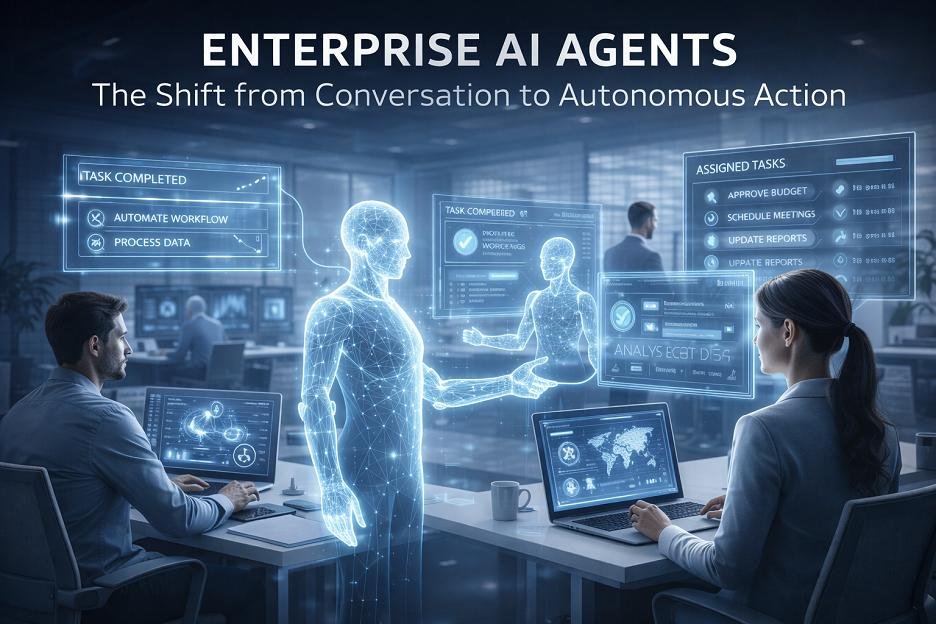
Enterprise AI Agents: The Shift from Conversation to Autonomous Action

In 2026, the corporate world has moved beyond the novelty of “chatting” with Large Language Models (LLMs). The focus has shifted toward Enterprise AI Agents—autonomous entities that do not just suggest text but execute complex, multi-step business processes across fragmented software ecosystems.
While 2024 was the year of the “Co-pilot,” 2026 is the year of the “Agentic Workflow.” These systems possess the reasoning, planning, and tool-access capabilities required to solve problems that previously demanded human intervention.
Industries Leading the Agentic Revolution
The adoption of Enterprise AI agents is no longer uniform. Specific sectors have pulled ahead by embedding “Agentic AI” into their mission-critical operations.
Financial Services: The Era of Autonomous Compliance
In the financial sector, agents are utilized for more than just customer service bots. They are now the primary line of defense in Fraud Detection and Regulatory Compliance.
-
Use Case: When an anomaly is detected in cross-border payments, an AI agent can independently freeze the transaction, query the internal KYC (Know Your Customer) database, cross-reference the latest AML (Anti-Money Laundering) regulations, and draft a SAR (Suspicious Activity Report) for human review.
-
Outcome: Reduction in manual compliance overhead by nearly 55%.
Healthcare: Clinical Decision Support & Documentation
Healthcare agents are tackling the “burnout crisis” by acting as digital scribes and research assistants.
-
Use Case: Clinical agents monitor patient vitals via IoT devices, autonomously updating Electronic Health Records (EHR) and alerting specialists only when data patterns suggest a high risk of sepsis or cardiac events.
-
Outcome: A 30% increase in patient face-time for clinicians.
Manufacturing: Supply Chain Orchestration
Manufacturing has moved from “just-in-time” to “autonomous-in-time” logistics.
-
Use Case: Supply chain agents monitor global shipping lanes and geopolitical events. If a port strike is predicted, the agent can autonomously negotiate with secondary suppliers in the ERP system to ensure production lines do not halt.
ROI Analysis: The Hard Numbers of 2026
For the first time since the AI boom began, Chief Financial Officers (CFOs) are seeing measurable, double-digit returns on AI investments. The ROI of agentic systems is fundamentally different from early Generative AI.
| Metric | Generative AI (2024) | Agentic AI (2026) |
| Primary Value | Speed of content creation | Speed of task execution |
| Human Involvement | High (constant prompting) | Low (supervisory role) |
| Average ROI | 8% – 12% | 22% – 35% |
| Error Reduction | Minimal | 60% improvement via self-correction |
The Productivity Multiplier: Companies utilizing multi-agent systems (where agents talk to other agents) report a “multiplier effect.” For instance, a marketing agent generating a campaign can now trigger a legal agent to verify trademarks and a procurement agent to buy ad space—all without a human clicking “send.”
Case Examples: Theory in Practice
Case Study 1: Global Retailer (Customer Journey Orchestration)
A major fashion retailer deployed a “Personal Stylist Agent.” Unlike a chatbot, this agent has access to the user’s past purchase history, local weather forecasts, and real-time inventory levels.
-
The Action: The agent noticed a customer’s upcoming trip to a rainy climate and proactively messaged them with a curated “rainy-day” outfit that was currently in stock at their local store.
-
The Result: A 22% increase in conversion rates and a 15% decrease in returns.
Case Study 2: Tech Giant (DevOps Automation)
A Silicon Valley firm deployed “Maintenance Agents” across its cloud infrastructure.
-
The Action: These agents identify “zombie” cloud resources—servers that are running but not being used. The agents autonomously shut down these resources during off-peak hours and restart them as needed.
-
The Result: Annual cloud cost savings of $12M.
Implementation Strategy: From Pilot to Production
Deploying an Enterprise AI agent is not as simple as granting an LLM access to your files. It requires a structured, security-first strategy.
Step A: Identify “High-Action, Low-Risk” Workflows
Do not start with mission-critical financial reporting. Begin with workflows where the agent can provide immediate value with minimal risk, such as:
-
IT Service Desk ticket routing.
-
Employee onboarding documentation.
-
Meeting scheduling and minutes generation.
Step B: The “Human-in-the-Loop” (HITL) Framework
Every enterprise agent must operate within a “Graduated Autonomy” framework.
-
Level 1: Agent provides suggestions; Human executes.
-
Level 2: Agent executes; Human reviews within 24 hours.
-
Level 3: Agent executes autonomously; Human reviews “Exception Reports” only.
Step C: Governance and Guardrails
Enterprise agents require “Reasoning Guardrails.” This prevents the agent from making unauthorized purchases or leaking sensitive PII (Personally Identifiable Information). In 2026, leading firms use Zero-Trust AI architectures, where agents must “re-authenticate” before accessing high-security data siloes.
Step D: Specialized Model Selection
Move away from the “One Model to Rule Them All” mentality. Small, specialized models (SLMs) trained on domain-specific data often outperform large, general models at a fraction of the cost.
Summary: The Agentic Advantage
The competitive advantage in late 2026 belongs to the “Agentic Enterprise.” Organizations that successfully transition from chatting with AI to delegating to AI are seeing unprecedented gains in operational velocity. However, the path to success is paved with rigorous governance and a shift in corporate culture—from a workforce that manages tools to a workforce that manages agents.