Beyond the Hype: The Ultimate Guide to Web3 in 2026

If you asked a chief technology officer about Web3 three years ago, you likely received a polite eye roll. The industry was plagued by speculative excess, clunky user experiences, and regulatory ambiguity. But as we navigate 2026, the narrative has fundamentally shifted. The tourists have left, and the architects have stayed to build.
Web3 is no longer a fringe experiment. It is functioning digital infrastructure. Today, the Web3 solution market is on track to hit $74.02 billion this year, marking a nearly 30% year-over-year expansion. Crypto ownership has surpassed 741 million users globally, and decentralized applications (dApps) see an average of 4.2 million daily active wallets.
The internet is being quietly re-engineered. Ownership, identity, and value exchange are shifting away from centralized platforms and directly into the hands of users. For technology professionals, enterprise leaders, and creators, understanding this architectural shift is no longer optional.
Here is exactly where Web3 stands in 2026, what is driving its mainstream adoption, and how it will reshape the digital economy.
The End of Friction: Solving the UX Problem
For years, the biggest barrier to Web3 adoption was the user experience. Expecting a mainstream audience to manage 24-word seed phrases, bridge assets across fragmented networks, and calculate gas fees was an impossible ask.
In 2026, the underlying plumbing is finally invisible. Two breakthroughs have made interacting with a decentralized application as intuitive as opening a standard banking app.
Account Abstraction
Account abstraction represents the most significant leap in blockchain usability since the invention of the smart contract. By shifting from rigid Externally Owned Accounts (EOAs) to programmable smart contract wallets, the industry has eliminated “seed phrase anxiety”.
Leading wallets now utilize social logins, biometric authentication, and email recovery. Gas fees can be sponsored by the application developers or paid in whatever token the user holds. Industry reports indicate that integrating these account abstraction features reduces user onboarding friction by up to 90%.
Chain Abstraction
Historically, users needed separate wallets and native tokens for every distinct blockchain they interacted with. Chain abstraction protocols have completely hidden this complexity. Cross-chain bridges and messaging protocols now allow users to access multiple networks and liquidity sources from a single environment, without ever needing to manually switch networks or understand the underlying routing.
Enterprise Adoption: Public Networks Meet Private Compliance
We have moved past the era where enterprises built isolated, siloed blockchain proofs-of-concept. Major institutions are now deploying capital and infrastructure on-chain, utilizing platforms that blend the security of public networks with the strict compliance requirements of traditional finance.
Financial services is the most advanced vertical in this regard. Global asset managers and banks are relying on specific frameworks built for institutional demands:
-
Avalanche Evergreen Subnets: These purpose-built environments allow financial institutions to deploy fully permissioned blockchains. They feature custom validator sets and native KYC-gated access, meeting the strict compliance requirements of MAS, FSA, and ESMA regulators.
-
Ethereum with ERC-3643: Public Ethereum has become a viable institutional layer thanks to the ERC-3643 standard (the T-REX protocol), which bakes transfer restrictions and investor whitelisting directly into smart contracts. Heavyweights like BlackRock and Franklin Templeton utilize this for tokenized fund products.
-
R3 Corda & Hyperledger Fabric: For operations where transaction-level privacy is absolute—such as syndicated lending or multi-bank settlement—these consortium-driven platforms remain dominant.
The Tokenization of Everything: Real-World Assets (RWAs)
Real-world asset tokenization is currently the largest growth category in Web3. Assets that have historically suffered from illiquidity—such as commercial real estate, private equity, fine art, and supply chain invoices—are being represented on-chain.
Industry analysts project the tokenized asset market will exceed $16 trillion by 2030.
The strategic impact here is massive. Tokenization allows for fractional ownership, meaning a retail investor can hold a programmable fraction of a commercial high-rise. For businesses, balance-sheet items that traditionally required weeks to finance can now be collateralized in days on decentralized lending protocols. The focus has moved from purely digital, speculative assets to connecting blockchain infrastructure directly to real-world economic activity.
Decentralized Physical Infrastructure Networks (DePIN)
While finance dominates the headlines, Decentralized Physical Infrastructure Networks (DePIN) are quietly challenging traditional cloud and telecommunications monopolies.
DePIN uses crypto-economic incentives to bootstrap physical hardware networks. Instead of a single corporation building out a massive network of servers, cell towers, or sensors, individuals purchase and deploy the hardware. In exchange for providing connectivity, storage, or compute power to the network, they earn tokens.
This model is proving highly capital-efficient. Decentralized storage networks and wireless mapping protocols are scaling faster and cheaper than their centralized counterparts. By 2026, DePIN is proving that crowdsourced infrastructure can rival the reliability of legacy tech giants, distributing the financial upside to the operators actually maintaining the hardware.
The Convergence of AI and Web3
Artificial intelligence and blockchain are fundamentally complementary technologies. Where AI acts as an engine of boundless generation and automation, Web3 serves as a layer of verification, scarcity, and ownership.
One of the most fascinating developments of 2026 is the rapid emergence of AI DAOs (Decentralized Autonomous Organizations). These are governance systems where AI agents do not just assist human voters, but actively participate in and autonomously execute on-chain decisions.
Furthermore, as AI-generated content floods the internet, blockchain provides the necessary cryptographic proof to verify human-created media. Zero-knowledge proofs are being deployed to verify training data integrity, ensuring that AI models are trained on unbiased, properly licensed information without exposing the underlying sensitive data.
The Web3 Creator Economy: A New Tech Stack
Web3 changes the power dynamic for digital creators. Instead of renting an audience from a centralized platform that takes a massive cut of revenue, creators utilize NFT-based royalty infrastructure and tokenized IP licensing to build direct economic relationships with their fans.
This shift in ownership has sparked a parallel shift in the software stack. Creators focused on digital sovereignty are increasingly auditing the tools they use to produce content. For instance, a digital artist minting scalable vector graphics (SVGs) directly to a blockchain might ditch legacy software entirely, opting for an open-source Adobe Illustrator alternative to ensure their creative stack matches the decentralized, collaborative ethos of the network they are publishing on. The focus is entirely on interoperability, open standards, and true ownership of intellectual property.
The Shifting Geography of Innovation
The future of decentralization is no longer centered exclusively in Silicon Valley. A massive geopolitical power shift has occurred, establishing the Middle East as the new center of Web3 innovation.
While Western regulators spent years engaged in enforcement-by-action and legal ambiguities, regions in the Middle East built bespoke regulatory frameworks to attract builders.
Riyadh and Abu Dhabi are the preferred launchpads for the decentralized economy in 2026. Driven by Saudi Arabia’s Vision 2030, Riyadh is building Web3 infrastructure on a massive scale. Meanwhile, Abu Dhabi’s ADGM and VARA regulations provide the exact institutional stability and clear guidelines that global enterprises require to experiment and deploy capital safely.
Web2 vs. Web3: The 2026 Architecture
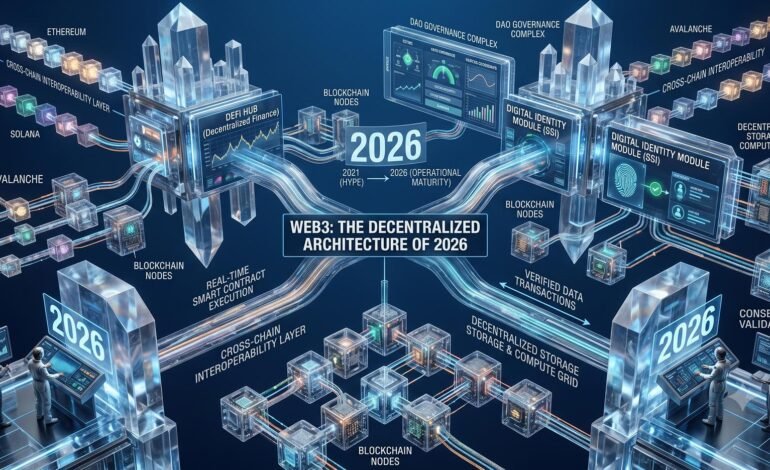
To understand how fundamentally different the current iteration of the internet is from its predecessor, we have to look at the architectural baseline. The Web2 vs. Web3 framing is no longer an academic debate; it is an operational reality.
| Architectural Layer | Traditional Web2 Model | 2026 Web3 Model |
| Identity & Authentication | Controlled by centralized platforms (Google, Meta). Subject to arbitrary bans. | Decentralized Identity (DID). Users hold cryptographic keys proving who they are. |
| Data Ownership | Harvested and monetized by platforms. Stored in centralized server farms. | Owned by the user. Stored on decentralized networks (IPFS, Arweave) or secured via encryption. |
| Financial Rails | Reliant on legacy payment processors, banks, and clearinghouses. Slow settlement. | Native digital settlement via stablecoins and smart contracts. Instant, borderless transactions. |
| Governance & Rules | Decided by a corporate board and closed-source algorithms. | Managed by Decentralized Autonomous Organizations (DAOs) via transparent smart contracts. |
| Backend Infrastructure | Monolithic cloud providers (AWS, Azure) vulnerable to single points of failure. | Decentralized Physical Infrastructure Networks (DePIN) and distributed node operators. |
Challenges on the Horizon
Despite the massive strides made, Web3 in 2026 is not without friction points.
Regulatory fragmentation remains a persistent headache. While regions like the Middle East and parts of Asia have established clear rules, other global markets still operate under patchwork legislation that creates compliance risks for multinational deployments.
Additionally, the integration of Web3 with legacy enterprise systems—technical debt accumulated over decades—requires complex middleware solutions. Businesses cannot simply switch off their traditional databases; they must run parallel systems, which increases short-term operational complexity.
Finally, while zero-knowledge proofs have improved transaction confidentiality, balancing total transparency on public ledgers with corporate data privacy laws (like GDPR) requires ongoing cryptographic refinement.
The Bottom Line
The defining characteristic of Web3 in 2026 is its quiet competence. The flashy speculative cycles have burned out, leaving behind a robust, globally distributed trust layer that sits underneath conventional applications.
From financial institutions settling tokenized assets on permissioned subnets to individual creators reclaiming their digital property rights, the decentralized web is no longer a future concept. It is the active, functioning reality of the modern internet. The question for businesses and professionals is no longer whether Web3 will survive, but how quickly they can integrate its architecture into their own operations before they are outpaced by those who already have.