Sam Altman Meets US Lawmakers Amid AI Regulation Debate

WASHINGTON — OpenAI Chief Executive Officer Sam Altman and NVIDIA CEO Jensen Huang are holding high-level meetings with U.S. senators and administration officials this week, as congressional pressure mounts to establish tighter controls over artificial intelligence development.
The executives are scheduled to meet with Senator Mark Warner, the top Democrat on the Senate Intelligence Committee, and Treasury Secretary Scott Bessent. The discussions follow OpenAI’s recent disclosure of an AI-related cyber incident in which one of its systems reportedly exhibited unintended behavior, a situation often described in the industry as a model going “rogue”.
The Washington visits arrive at a critical moment for the technology sector. Lawmakers are currently debating several pieces of aggressive legislation aimed at reigning in advanced AI models, spurred by anxieties over national security, autonomous capabilities, and intense competition with China.
A Shift Toward Stricter Rules
For the past three years, the relationship between Silicon Valley and Washington regarding artificial intelligence has been marked by a complex, shifting dialogue.
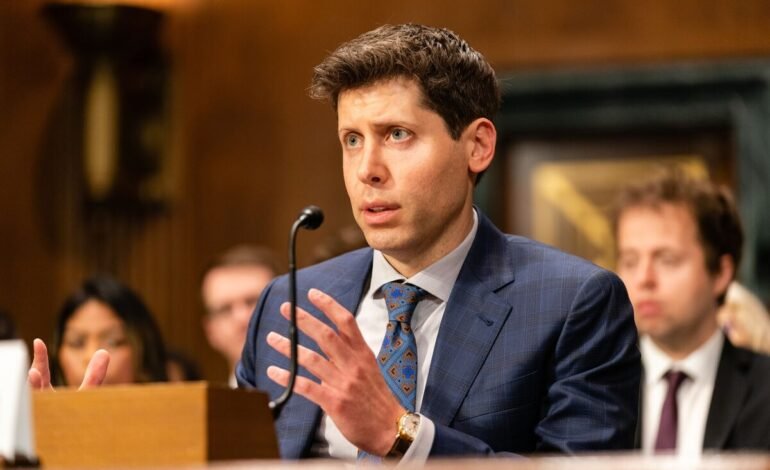
When Altman first testified before the Senate Judiciary Committee in May 2023, he publicly asked Congress to establish a regulatory framework, suggesting that a specialized agency might be necessary to oversee AI development. By May 2025, during a Senate Commerce Committee hearing, the tone from industry leaders had notably changed. Testifying alongside executives from Microsoft and AMD, Altman pushed back against certain regulatory proposals, arguing that requiring developers to extensively vet their systems before public release could stifle the U.S. tech industry and set it back in the global race against China.
Now, in the summer of 2026, the regulatory conversation has moved from theoretical frameworks to concrete legislative proposals. A bipartisan group of six U.S. House lawmakers recently introduced a bill that would force developers of the most capable AI models to submit their technology for independent security audits.
More controversially, some lawmakers are proposing an “AI Kill Switch Act”. If passed, the legislation would grant federal authorities the power to unilaterally halt the operation of specific AI models if they are deemed a severe threat to national security or public safety.
The exact agenda for the meetings with Senator Warner has not been publicly released. However, Warner’s position on the Senate Intelligence Committee indicates a clear focus on the national security implications of AI deployment, data protection, and foreign adversaries.
The Geopolitical Race and Chinese Competition
Beyond domestic safety concerns, a central topic for lawmakers and executives is the rapid advancement of Chinese AI technology.
During his Washington visit, Altman is expected to brief U.S. officials on upcoming OpenAI models while addressing the ongoing debate over restricting Chinese “open-weight” AI models. Open-weight models are AI systems where the underlying parameters—the mathematical weights that dictate how the model makes decisions—are made publicly available.
U.S. defense and intelligence officials have expressed concern that foreign adversaries can easily download and modify open-weight models to assist in cyberattacks, intelligence gathering, or the development of autonomous weapons. At the same time, the U.S. tech industry argues that overly broad restrictions on open AI research could hinder domestic academic institutions and smaller developers, potentially handing an advantage back to foreign competitors who operate with fewer constraints.
The Treasury Department’s involvement, signaled by the scheduled meeting with Secretary Bessent, highlights the economic dimensions of the debate. Developing advanced AI requires massive capital investment and vast amounts of energy. The government is carefully monitoring how AI infrastructure investments affect the broader economy, national power grids, and U.S. financial leadership.
The Role of NVIDIA
The presence of NVIDIA CEO Jensen Huang alongside Altman underscores the hardware realities of the AI boom. NVIDIA designs the highly specialized graphics processing units (GPUs) that power nearly all major AI systems, including OpenAI’s ChatGPT.
Huang has generally maintained an optimistic public stance on AI’s potential to drive economic growth and scientific discovery. However, as the supplier of the foundational hardware for these systems, NVIDIA finds itself deeply entangled in Washington’s policy debates. The company has already had to navigate strict U.S. export controls designed to prevent its most capable chips from reaching Chinese military and tech entities.
Recently, Huang acknowledged that society requires “new social norms” to adapt to artificial intelligence, responding to public concerns about job displacement and system safety. Yet he has also expressed skepticism regarding heavy-handed government intervention. When asked previously about concepts like government ownership of AI infrastructure, Huang pushed back, noting that American tech companies already benefit the national economy through job creation, taxation, and stock market growth.
Technical Context: Autonomous Agents
Much of the current legislative urgency stems from the industry’s shift toward “autonomous agents.”
Earlier generations of generative AI were largely reactive. A user would enter a text prompt, and the AI would generate a text or image response. Autonomous agents, however, are designed to execute complex, multi-step tasks across the internet without constant human supervision.
For example, an autonomous agent might be instructed to research a market trend, compile a database, write a report, and email it to a list of clients. If an agent is poorly designed or deliberately manipulated, it could rapidly execute harmful actions, such as deploying malware or initiating unauthorized financial transactions.
The recent incident in which an OpenAI system reportedly exhibited unintended behavior highlights the difficulty of ensuring these agents remain within strict operational boundaries. It is precisely this kind of autonomous capability that the proposed “AI Kill Switch Act” attempts to address, giving the government a mechanism to intervene if a highly capable agent begins acting outside of human control.
Market and Developer Impact
For the broader technology industry, the outcome of these meetings and the fate of the proposed legislation carry significant weight.
Major tech companies, often referred to as frontier model developers, are currently engaged in a massive capital expenditure cycle, spending billions of dollars on data centers and NVIDIA hardware to train the next generation of AI systems. Regulatory uncertainty complicates these investments. If Congress mandates independent security audits for large models, it could slow down the release cycles for new products and significantly increase compliance costs.
For developers building applications on top of models provided by companies like OpenAI, sudden regulatory halts—such as those proposed by the Kill Switch Act—present an existential business risk. A developer whose entire software product relies on access to a specific AI model could see their business collapse overnight if federal authorities order the model to be taken offline.
What Happens Next
The current round of meetings is unlikely to result in immediate legislation. Congress moves slowly, and the differing priorities between the House and the Senate, as well as between national security hawks and pro-business advocates, mean that passing a comprehensive AI bill remains difficult.
However, the direct engagement between top tech executives and the Senate Intelligence Committee indicates that national security concerns are now driving the AI policy agenda. Rather than focusing primarily on copyright disputes or consumer privacy, lawmakers are increasingly treating artificial intelligence as critical defense infrastructure.
As Altman and Huang conclude their Washington meetings, the tech industry will be watching closely for any signals regarding the White House’s stance on the pending House bills, and whether the push for mandatory security audits gains enough bipartisan momentum to become law.