Samsung Galaxy Z TriFold Faces Supply Chain and Cost Pressures

The premium smartphone sector is undergoing a structural realignment as manufacturers transition from single-hinge foldables to complex multi-panel configurations. Samsung Electronics, historically the volume leader in flexible display technology, formalized this shift with the commercial introduction of the Galaxy Z TriFold.
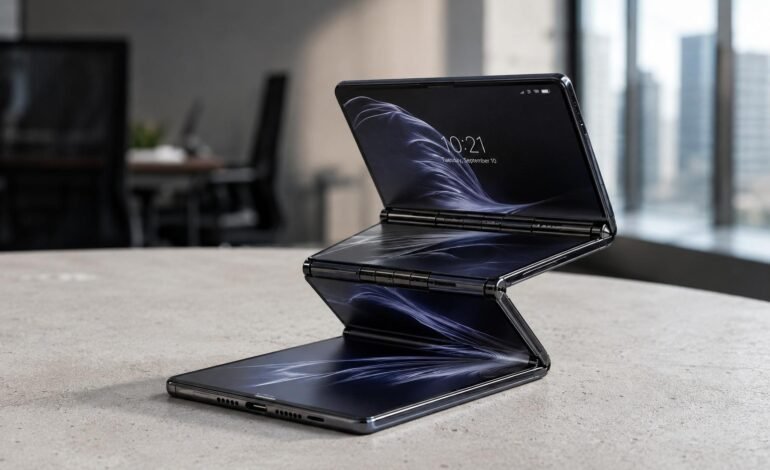
The device represents a departure from the established form factors defined by the Galaxy Z Fold and Z Flip series. By utilizing a dual-hinge system that folds a continuous OLED panel into three distinct segments, the device attempts to bridge the structural divide between a pocketable mobile handset and a full-scale workstation.
However, the commercial trajectory of the device highlights the severe industrial bottlenecks associated with manufacturing flexible displays at scale. While early concepts showcased at international trade exhibitions suggested a straightforward progression from prototype to mass production, the reality of the global supply chain has forced a more cautious approach.
The initial commercial rollout focused on high-GDP target regions, including South Korea, Singapore, Taiwan, the United Arab Emirates, and the United States. Despite rapid inventory depletion during early sales cycles, structural profitability challenges have complicated the long-term lifecycle of this first-generation hardware.
Historical Context: From Prototypes to Commercial Reality
The development of the Galaxy Z TriFold traces back several years through Samsung Display’s public exhibition roadmaps. At the Consumer Electronics Show (CES) and Mobile World Congress (MWC) between 2022 and 2025, the conglomerate routinely demonstrated its “Flex S” and “Flex G” concepts. These prototypes illustrated two distinct folding methodologies: an outward-and-inward “S” configuration and an all-inward “G” configuration designed to protect the primary panel from external abrasions.
Samsung eventually committed to the dual-rail, Z-shaped folding configuration for its commercial variant. This layout allows one segment of the main panel to serve as an accessible cover display when the device is completely closed, bypassing the need for a separate, secondary external display panel.
The strategic validation for this engineering direction arrived in late 2024, when Huawei Technologies launched the Mate XT in the Chinese domestic market. The emergence of a direct competitor accelerated Samsung’s timeline, shifting the enterprise from iterative testing into formal commercial production by late 2025.
Core Technical Specifications and Mechanical Engineering
The primary value proposition of the Galaxy Z TriFold centers on its internal display geometry. Unfolded, the main display measures 10.0 inches diagonally, featuring a QXGA+ Dynamic AMOLED 2X panel with a resolution of 2160 × 1584 pixels. The display operates with a 120 Hz adaptive refresh rate and achieves a peak brightness rating of 1,600 nits under direct light conditions, supported by a hardware-level booster matrix.
When fully retracted, the device transitions into a traditional smartphone profile with a 6.5-inch cover display. This external surface features a resolution of 2520 × 1080 pixels and supports an elevated peak brightness of 2,600 nits. The external layer is reinforced with specialized ceramic glass compounds to mitigate impact stress.
SAMSUNG GALAXY Z TRIFOLD SPECIFICATIONS
| Main Display | 10.0-inch QXGA+ Dynamic AMOLED 2X (2160 × 1584) |
| Cover Display | 6.5-inch Full HD+ Dynamic AMOLED 2X (2520 × 1080) |
| Internal Processor | Qualcomm Snapdragon 8 Elite for Galaxy (3 nm) |
| Memory Configuration | 16 GB LPDDR5X RAM |
| Storage Options | 512 GB / 1 TB UFS 4.0 |
| Primary Camera | 200 MP Main (OIS) + 12 MP Ultra-Wide + 10 MP Tele |
| Battery Capacity | 5,600 mAh total across three separate cells |
| Physical Dimensions | Folded: 12.9 mm thick | Unfolded: 3.9 to 4.2 mm |
| Total Device Weight | Approximately 309 grams |
Achieving these tolerances required an overhaul of Samsung’s hinge architecture. The device utilizes dual-rail titanium hinges designed to distribute mechanical tension evenly across the fold axes.
When unfolded, the central chassis measures between 3.9 mm and 4.2 mm in thickness, depending on the component distribution of the individual panel segments. Closed, the cumulative thickness reaches 12.9 mm, making it roughly one-third thicker than the single-hinge Galaxy Z Fold 7.
Supply Chain Dynamics and Manufacturing Bottlenecks
The structural bottleneck for multi-folding devices remains the yield rate of the flexible substrate layers. Manufacturing a 10-inch continuous flexible AMOLED panel capable of surviving opposing folding radii requires precise control over layer stack tension.
The inner radius requires an ultra-tight fold that compresses the display materials, while the outer radius stretches the components across the exterior hinge mechanism.
Industrial analysis reports indicate that the production costs for these specialized display assemblies remain exceptionally high compared to traditional rigid panels or single-fold modules. Sources within the East Asian component supply chain suggest that the bill of materials (BOM) for the dual-hinge assembly alone accounts for a disproportionate share of the device’s manufacturing budget.
These high costs are compounded by the complex three-cell battery architecture. To maintain a balanced center of gravity and prevent localized thermal build-up, Samsung distributed a total capacity of 5,600 mAh across three distinct physical cells located within each chassis section.
The integration of these power modules requires multi-channel power delivery ICs (integrated circuits) capable of managing variable discharge rates across separate physical zones.
Software Optimization and the Multitasking Interface
Hardware innovation remains incomplete without an equivalent adaptation of the underlying operating system. The Galaxy Z TriFold operates on Android 16, overlaid with Samsung’s proprietary One UI 8 interface. The primary software challenge involves managing real-time aspect ratio transitions as the user unfolds successive segments of the display panel.
The operating system handles window management through a dynamic grid system. When fully extended to its 4:3 canvas aspect ratio, the software permits three portrait-oriented mobile applications to run concurrently side-by-side without scaling distortions.
Furthermore, the system can transition into an integrated desktop environment, utilizing the lower third of the folded screen as an input interface while the remaining panels function as a primary monitor.
Application developers face hurdles when optimizing software for these shifting layout requirements. While standard Android apps scale across standard tablet resolutions, the sudden transition from a 21:9 external aspect ratio to an interim dual-panel aspect ratio, and finally to a 4:3 triple-panel configuration, occasionally results in interface rendering bugs or forced application restarts.
Industry Perspective: The Battle for Premium Market Share
From a broader market perspective, the multi-fold category represents a defensive and offensive imperative for Samsung Electronics. In the domestic Chinese market, Western European corridors, and premium Asian hubs, traditional single-fold sales face saturation. The introduction of high-end hardware allows manufacturers to justify pricing thresholds well above the standard $1,500 premium line.
“The expansion into triple-folding form factors is less about immediate volume and more about securing technological leadership,” notes a senior hardware analyst tracking East Asian supply chains. “By deploying an active commercial device, an enterprise secures critical field data regarding long-term hinge wear, polymer degradation, and real-world consumer usage patterns that cannot be replicated in a laboratory environment.”
The primary competitive point of comparison remains Huawei’s premium multi-fold hardware. While Huawei captured early market mindshare within mainland China, its global distribution footprint remained constrained by ongoing trade restrictions and software ecosystem limitations. Samsung’s global model counterbalanced this by integrating full Google Mobile Services compatibility and an international retail distribution infrastructure.
Financial Realities and Market Discontinuation
The long-term commercial sustainability of the current Galaxy Z TriFold platform remains constrained by its retail pricing and underlying margins. Launching in the United States at a base price of $2,899, the device represents one of the most expensive consumer mobile devices brought to market outside of luxury branding partnerships.
Despite high demand from enterprise clients and early adopters, reports surfaced within the financial sector indicating that Samsung encountered margin compression due to the volatile yield rates of the 10-inch display panel.
The high scrap rate of defective flexible assemblies during quality control inspections made sustained production financially unviable.
Consequently, the first-generation model experienced a truncated production cycle, with sales winding down in major markets like the United States, South Korea, and Singapore a few months post-launch. This maneuver allowed Samsung to fulfill initial promotional allocations while preventing sustained financial losses from open-ended manufacturing runs.
Future Outlook: The Development of Second-Generation Hardware
The cessation of the initial Galaxy Z TriFold production cycle does not signal the termination of the form factor. Patent documentation filed with global intellectual property offices indicates that Samsung is actively addressing the structural liabilities identified during the first-generation production run.
Engineering initiatives for the next iterative cycle focus on two clear vectors: chassis thickness reduction and structural optimization of the folding joint.
Engineers are exploring ultra-thin carbon-fiber composite matrices for the internal frame components to reduce the device’s overall weight below the 300-gram mark.
Concurrently, developments in next-generation ultra-thin glass (UTG) chemistry aim to improve the resilience of the central fold line, reducing the visibility of the display crease while lowering overall component assembly costs.
Conclusion
The first-generation Samsung Galaxy Z TriFold has served its purpose as an industrial proof of concept, establishing that a 10-inch triple-folding multi-panel device can successfully transition from an exhibition prototype into a functional commercial device.
While high production costs and supply chain constraints limited its market lifecycle, the device provided Samsung with valuable engineering insights and field data. As the enterprise refines its display yields and hinge designs for future iterations, the multi-fold architecture will continue to serve as the benchmark for high-end mobile productivity hardware.
Frequently Asked Questions
What is the primary screen size of the Galaxy Z TriFold?
The internal main display measures 10.0 inches diagonally when completely unfolded. When closed, the device utilizes a 6.5-inch external cover screen for standard operation.
How thick is the device when folded completely?
The device measures 12.9 mm in thickness when completely closed. When fully opened, the individual panels range from 3.9 mm to 4.2 mm in thickness.
What processor powers the Galaxy Z TriFold?
The smartphone is powered by the Qualcomm Snapdragon 8 Elite for Galaxy chipset, manufactured on a 3-nanometer process node.
What is the total battery capacity, and how is it distributed?
The device features a total battery capacity of 5,600 mAh. This capacity is divided across three separate physical cells located within each of the three chassis panels to optimize weight distribution and thermal dissipation.
Does the device support fast charging?
Yes, the hardware supports 45-watt wired fast charging, which can charge the battery from 0% to 50% in approximately 30 minutes. It also supports 15-watt wireless charging and 4.5-watt reverse wireless charging.
What camera hardware is included in the rear module?
The main rear camera array features a 200-megapixel primary sensor with optical image stabilization, a 12-megapixel ultra-wide lens, and a 10-megapixel telephoto lens supporting 3x optical zoom.
Why did Samsung limit the production run of the first-generation model?
High manufacturing costs and low display substrate yield rates made continuous large-scale production unprofitable. The initial run allowed the company to collect field data while managing production expenses.
What operating system does the device run?
The Galaxy Z TriFold launches with Android 16, running Samsung’s specialized One UI 8 user interface customized for multi-window layout transitions.
Is the Galaxy Z TriFold dust and water-resistant?
The hardware carries an official IP48 rating, providing certified water resistance along with protection against solid foreign objects greater than 1 mm in size.
When will a second-generation model be available?
While Samsung has not announced an official launch date, patent filings and supply chain indicators reveal that a lighter, thinner second-generation triple-folding device is currently in development.