Why Taiwan Controls the Pace of the Global AI Hardware Race

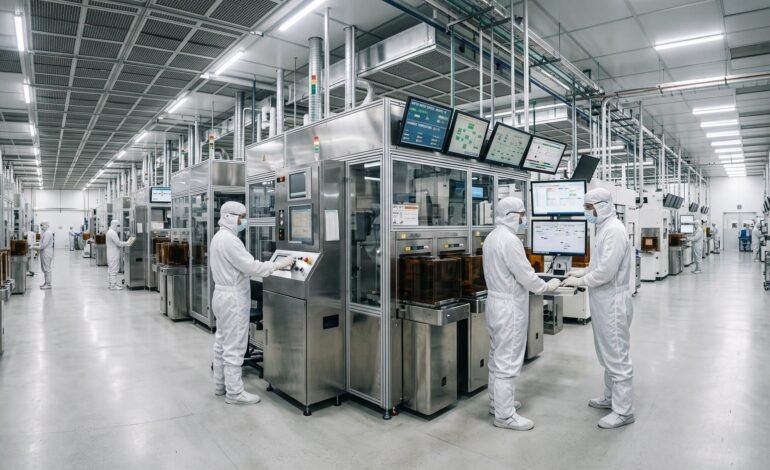
TAIPEI — The speed at which global technology companies deploy artificial intelligence now depends heavily on physical manufacturing constraints located in Taiwan.
While software developers in California race to build larger language models, the hardware required to run them is bottlenecked by highly specialized fabrication and assembly processes concentrated on a single island. Taiwan has long been recognized as the world’s primary source for advanced semiconductors. However, the unique technical demands of modern AI systems have allowed Taiwanese companies to capture an even larger share of the underlying infrastructure market.
Taiwan Semiconductor Manufacturing Company (TSMC) clarified the extent of this demand in July 2026 when it reported its second-quarter earnings. The world’s largest contract chipmaker posted a record NT$1.27 trillion ($39.62 billion) in revenue, representing a 36 percent year-over-year increase that comfortably exceeded its own financial guidance. Net profit reached approximately NT$632.6 billion ($19.65 billion), driven primarily by the steady volume of orders for AI hardware.
Yet the most critical detail from the earnings period was not the revenue figure itself, but a severe production constraint: TSMC’s advanced packaging capacity is entirely sold out through the end of 2026, with lead times stretching well into 2027.
The Packaging Bottleneck
For decades, the semiconductor industry focused almost entirely on shrinking transistors to fit more computing power onto a single piece of silicon. AI has forced a shift in this approach.
Modern AI accelerators, such as those designed by Nvidia and AMD, are too large and complex to be manufactured as a single traditional chip. Instead, companies design multiple smaller silicon components that must be bound together to function as a unified processor. This process requires a specialized technique known as Chip-on-Wafer-on-Substrate, or CoWoS.
CoWoS is currently the primary binding constraint on the global AI trade. Without it, the raw silicon wafers produced in fabrication plants cannot be assembled into functional hardware. TSMC handles the overwhelming majority of global CoWoS packaging.
Industry analysts estimate that total CoWoS demand has nearly tripled over the past two years, moving from roughly 370,000 wafers in 2024 to an expected 1.0 million wafers in 2026. TSMC is aggressively expanding its lines, targeting between 120,000 and 130,000 wafers per month by late 2026. Despite this rapid expansion, the production queues remain fully booked, with lead times extending between 52 and 78 weeks.
The demand is highly concentrated. Nvidia alone is estimated to consume roughly 60 percent of TSMC’s packaging capacity, while the top three customers account for more than 85 percent of the available supply. For technology executives planning data center expansions, this means that securing a slot to manufacture the raw silicon is insufficient; they must also secure a slot in the packaging queue.
The technical hurdles run deep. TSMC’s CoWoS comes in different variations, and both primary families—CoWoS-S, which uses a silicon interposer, and CoWoS-L, which utilizes localized silicon bridges—are operating at maximum capacity. CoWoS-L is particularly vital, as it serves as the foundation for Nvidia’s newer Blackwell architectures.
Another critical factor closely tied to Taiwan’s packaging dominance is High Bandwidth Memory (HBM). HBM chips provide the rapid data access necessary for training large AI models and must be stacked directly adjacent to the processors during the CoWoS packaging process. Even if a company successfully sources memory chips from suppliers like SK Hynix, those components cannot be deployed without the corresponding packaging capacity in Taiwan. Consequently, prices for HBM components have risen by double-digit percentages as the entire supply chain strains to keep up.
Beyond the packaging bottleneck, the next generation of raw semiconductor fabrication is already facing similar constraints. TSMC’s upcoming 2-nanometer process, which is expected to begin mass production soon, is heavily booked well into 2028 by early adopters in the high-performance computing and mobile sectors.
Moving Up the Hardware Chain
Taiwan’s influence on the AI industry extends past TSMC and into the complex physical assembly of the servers that house these chips.
Building an AI data center is fundamentally different from outfitting a traditional cloud computing facility. The latest server architectures consume massive amounts of electricity and generate immense heat. They require sophisticated liquid cooling systems and complex printed circuit boards (PCBs) that can transmit high-speed data without interference.
Taiwanese electronics manufacturers, including Foxconn and Quanta Computer, have established a dominant position in assembling these high-end systems. Foxconn and Quanta are handling the vast majority of global assembly for the Nvidia GB200 AI servers, with Foxconn taking an estimated 40 percent share and Quanta securing 30 percent.
The financial stakes in this assembly process are exceptionally high. A single fully outfitted AI server rack can cost tens of millions of dollars. The systems contain dense layers of interconnected components, meaning a single defect can cause catastrophic hardware failure.
To manage these risks, Taiwanese suppliers are implementing new quality control measures. Quanta, for instance, has partnered with the German optics firm Zeiss to deploy non-destructive testing technologies on server PCBs. Some of these boards contain up to 40 layers of circuitry. A minor misalignment during lamination can render a high-value system unusable, making advanced interior inspection critical to maintaining yield rates and meeting delivery schedules.
Foxconn is also expanding its infrastructure footprint. The company displayed physical infrastructure for enterprise AI factories at recent industry events, showcasing large-scale liquid cooling solutions designed to support massive language models.
Furthermore, Foxconn is deploying these technologies domestically. The company is currently building Taiwan’s fastest AI supercomputer at its computing center in Kaohsiung. The facility will feature 64 GB200 NVL72 racks, comprising 4,608 Blackwell GPUs and 2,304 Grace Arm server processors. This deployment highlights how Taiwanese firms are increasingly acting as direct consumers of the technology they build, integrating AI into their own smart manufacturing platforms.
Geopolitics and Supply Chain Security
The concentration of this critical infrastructure in Taiwan has profound geopolitical implications, a reality that the local government is increasingly highlighting on the global stage.
In June 2026, during the Computex technology conference in Taipei, Taiwan President Lai Ching-te addressed the island’s strategic position directly. He stated that maintaining the political status quo across the Taiwan Strait is not just a regional security issue, but a necessity for safeguarding global supply chains.
Lai framed Taiwan’s stability as a foundational requirement for the ongoing development of artificial intelligence worldwide. As tech giants deepen their reliance on Taiwanese manufacturing, the island is positioning itself as an indispensable node in the global economy. The current concentration of production means that any military or political disruption in the Taiwan Strait would immediately halt the expansion of global AI data centers and trigger severe economic consequences across the technology sector.
The government in Taipei is actively working to cement this status. The administration has introduced plans to build a resilient, “non-red” semiconductor supply chain—a clear reference to maintaining independence from mainland China. As part of a broader strategy dubbed the “Ten Major AI Infrastructure Projects,” Taiwan aims to train one million AI workers, ranging from basic technicians to advanced engineers.
This talent pipeline is designed to address a persistent vulnerability in the global hardware market. While the U.S. and European governments are spending tens of billions of dollars to subsidize domestic chip manufacturing through legislation like the CHIPS Act, building a fabrication plant is only the first step. Operating the plant, developing the packaging technology, and assembling the final servers require a deep pool of specialized engineering talent that Taiwan has cultivated over three decades.
The Limits of Diversification
Technology companies recognize the risks associated with this geographic concentration. Many have publicly discussed the need for supply chain diversification to build resilience against potential natural disasters or geopolitical conflict.
TSMC is responding to this pressure by constructing new fabrication facilities in the United States, Japan, and Germany. However, these overseas plants primarily focus on older manufacturing processes or serve specific regional markets, such as the automotive industry. The absolute most advanced technology—including the leading-edge nodes and the critical CoWoS packaging facilities—remains firmly rooted in Taiwan.
The physical reality of manufacturing dictates that expanding advanced production requires a massive cluster of supporting suppliers. Chemicals, specialized materials, testing equipment, and engineering contractors must all be located near the main fabrication plants. Taiwan has spent the last 30 years building this dense network. Attempting to lift and replicate this ecosystem in Arizona or Dresden requires significantly more time and capital than simply constructing the primary factories.
Additionally, the server assembly stage remains heavily concentrated in Asia. Even if a U.S. technology company successfully sources a semiconductor from a new plant in Ohio, that chip will likely still need to cross the Pacific for advanced packaging, and cross it again to be integrated into a server motherboard by a Taiwanese electronics manufacturer.
Market Impact
The financial markets have absorbed these realities, reflecting them in the valuations of Taiwanese hardware companies. While software and internet firms capture much of the public attention regarding artificial intelligence, hardware manufacturers have quietly secured substantial revenue streams.
TSMC’s valuation has surged in tandem with its production constraints, while companies like Foxconn have projected massive revenue contributions directly tied to AI server shipments. Foxconn has estimated that its GB200 series products, shipped in fully configured rack forms, could contribute up to 3 trillion yuan (approximately $413 billion) in revenue over the course of their deployment.
For the broader technology industry, the message from the 2026 production cycle is straightforward. Companies must align their software development roadmaps with the physical realities of Taiwanese manufacturing. Software engineers can write code at their own pace, but their programs cannot run until the hardware clears the packaging lines in Hsinchu and the assembly floors in Taoyuan.
As demand for computational power continues to climb, Taiwan is doing more than just participating in the global technology sector. It is dictating the schedule.