China’s Humanoid Robots Face Their Biggest Test: Factory Work

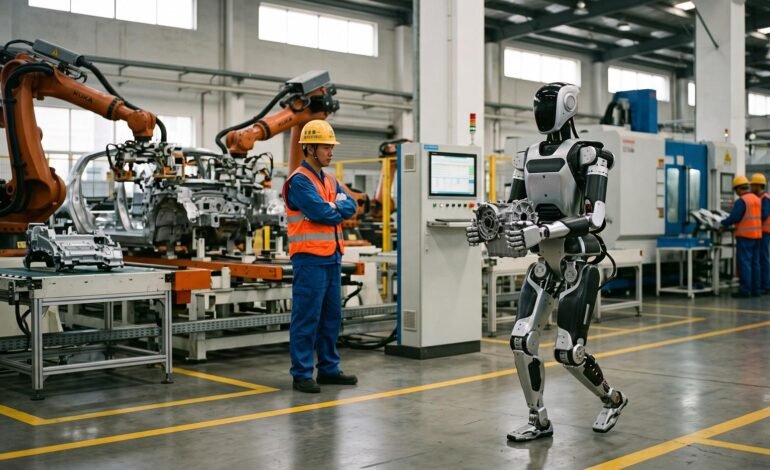
BEIJING — China’s robotics industry is producing bipedal machines at an unprecedented rate, driven by a national mandate to integrate artificial intelligence into heavy industry. But as state planners push to place thousands of these robots into commercial operations, manufacturers are discovering that building an agile robot is far easier than making it a reliable factory worker.
In June, China’s Ministry of Industry and Information Technology (MIIT) and the State-owned Assets Supervision and Administration Commission established a goal to deploy 10,000 humanoid robots into commercial use by the end of 2026. The directive requires local governments and state-owned enterprises to test embodied AI in manufacturing, logistics, retail, and healthcare environments.
The government projects that Chinese production of humanoid robots will exceed 100,000 units for the 2026 calendar year. This output would make China the undisputed global leader in bipedal machine manufacturing by volume.
However, shipment forecasts reveal a sharp divide between manufacturing capacity and actual industrial adoption. The sector is currently dominated by two companies: AgiBot and Unitree. Industry data indicates AgiBot plans to ship 15,000 units this year, while Unitree expects to complete roughly 11,000.
Despite these high production volumes, the majority of the hardware has yet to reach assembly lines. Approximately 70 percent of Unitree’s current humanoid robot revenue comes from universities, research institutions, and internal development teams rather than commercial factory deployments. Meanwhile, early market leader UBTech has missed its own internal delivery targets, stalling on the large-scale logistics and retail orders it projected last year.
Pilot Programs in Automaking
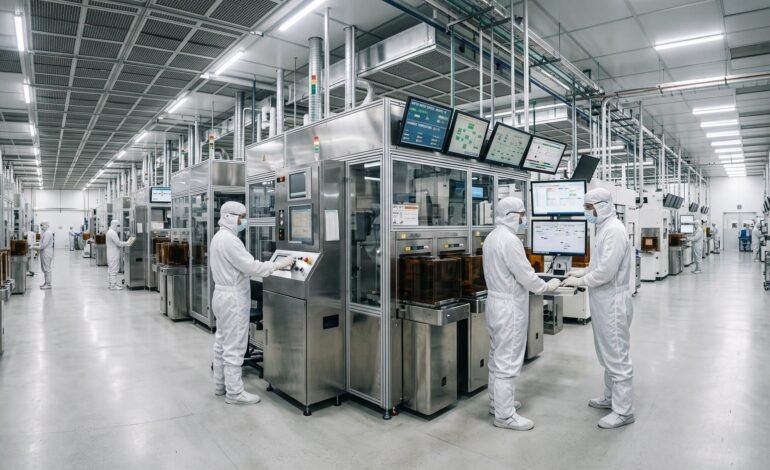
To bridge the gap between laboratories and commercial operations, Chinese robotics companies are heavily targeting the automotive and battery sectors for their initial pilot programs.
UBTech has initiated early testing of its robots at facilities run by electric vehicle manufacturers BYD and Geely, as well as at a FAW-Volkswagen plant in Qingdao. The company also partnered with contract manufacturing giant Foxconn to integrate humanoids into intelligent manufacturing processes. Unitree has similarly deployed its machines at factories owned by the EV maker Nio.
The battery supply chain is also serving as a testing ground. Spirit AI, another domestic robotics firm, recently placed its Xiaomo robot into final battery-pack testing at a facility owned by Contemporary Amperex Technology Co. Ltd. (CATL).
These pilot programs are designed to determine whether bipedal machines can effectively handle tasks like logistics sorting, industrial handling, and production-line loading.
The Economics of Factory Deployment
The primary argument for adopting humanoid robots is their physical flexibility. A bipedal robot can theoretically navigate environments built for humans and use standard hand tools without requiring companies to entirely redesign their factory floors.
Chinese hardware prices are already falling to levels that make this testing financially viable. Unitree’s G1 model is priced at approximately $16,000, positioning it among the lowest-cost humanoid platforms available globally.
Yet even at these prices, humanoid robots face steep competition from established automation technologies. A humanoid designed to move boxes must compete against autonomous mobile robots (AMRs), conveyor belt systems, and human workers. Currently, traditional automation options provide better cost-per-task economics in nearly all commercial facilities.
Technical Hurdles Remain
For mass adoption to materialize by the government’s 2026 deadline, engineering teams must resolve a series of structural hardware challenges.
While recent models excel at staged demonstrations—performing backflips, dances, and martial arts—they often struggle with the sustained rigor of heavy manufacturing. Current hardware suffers from severe battery lifespan constraints, limited physical payload capacities, and operational instability during complex tasks.
Unitree Founder Wang Xingxing recently addressed these limitations directly, noting that “large-scale commercial adoption remains uncertain due to challenges in task generalization, endurance, and safety in unstructured environments”.
The remainder of 2026 will serve as a critical window for the industry. Success will depend on whether companies like AgiBot and Unitree can announce large-scale commercial purchase orders—rather than research grants or small pilot programs—confirming that these machines can finally hold down a permanent job.