Apple’s iOS 27 Beta Introduces Smarter Siri With New AI Customization Options

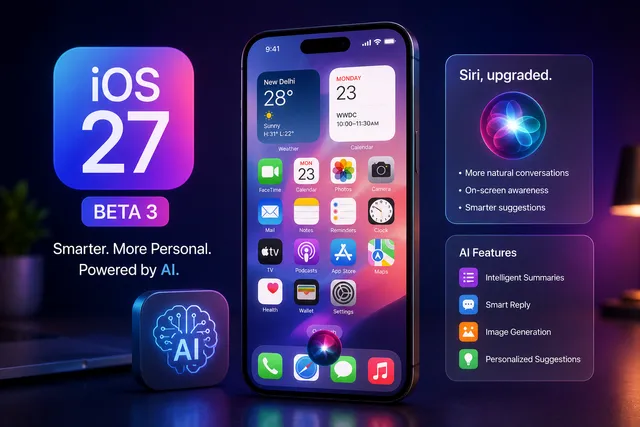
As Apple progresses through its summer development cycle for iOS 27, the latest beta release—Beta 3, seeded on July 6, 2026—has brought significant refinements to the platform’s centerpiece feature: the overhauled, AI-powered Siri.
Following the initial unveiling of “Siri AI” at WWDC26 in June, this latest update shifts from broad architecture improvements to user-facing personalization. Developers can now access two new customization sliders in the settings menu: “Pace” and “Expressivity.” These controls allow users to dictate the speed of Siri’s narration and the emotional nuance of its delivery, bringing the assistant’s output closer to human-like conversation.
The Evolution of the Digital Assistant
For years, Siri was primarily a task-based command system—reliable for setting timers or initiating calls, but often brittle when faced with complex, multi-step queries. The introduction of iOS 27 represents a fundamental departure from that model.
Built on the foundation of Apple Intelligence, the new Siri AI integrates deeply with the system’s “semantic index.” This allows the assistant to pull context from across the user’s digital life—including emails, messages, calendar events, and even current on-screen content—to provide highly tailored answers. The addition of “Pace” and “Expressivity” settings acknowledges that if a digital assistant is to be truly conversational, it must feel natural to the individual user, a design philosophy mirroring shifts seen in competing generative AI models.
Why This Matters
The shift toward customizable voice delivery is more than an aesthetic update; it signals a maturation of voice-based interfaces. By allowing users to modulate tone and speed, Apple is moving beyond the “one size fits all” robotic delivery that has characterized voice assistants for the last decade.
For professional users and those with accessibility needs, these controls are particularly significant. A faster, more concise pace can increase productivity for power users, while refined expressivity can improve comprehension and emotional engagement. As Apple Intelligence becomes more embedded in daily workflows, the ability to control the delivery method becomes as essential as the accuracy of the information provided.
Future Impact and Industry Context
The broader trajectory of iOS 27 suggests a future where the distinction between “searching for info” and “having a conversation” disappears. As highlighted by reports from sources like TechCrunch and MacRumors, the Siri AI initiative is a critical component of Apple’s competitive response in an industry rapidly being reshaped by generative AI.
Looking ahead, we can expect this personalization to expand further. As the model continues to learn from user interaction, the assistant may eventually adapt its tone automatically based on the nature of the request—shifting to a more neutral, professional delivery for workplace queries and a more conversational cadence for casual personal interactions.
Ultimately, these beta refinements represent a critical step in Apple’s attempt to reconcile high-performance AI with its signature focus on user-centric design. By putting these customization levers in the hands of the user, Apple is betting that the key to long-term adoption of AI is not just raw capability, but the feeling of agency and personalization that a tailored interface provides.
News sources included: Apple Newsroom, MacRumors, TechCrunch, and Gadgets360.