Microsoft AI Strategy Delivers: Strong Forecast Boosts Shares

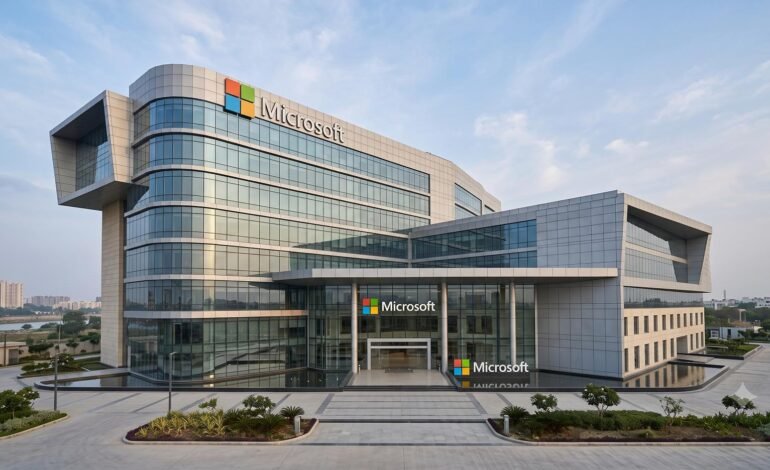
Microsoft’s substantial investments in artificial intelligence infrastructure are beginning to translate into concrete financial returns, as the company reported a sharp rise in cloud revenue and issued an optimistic growth forecast for the current quarter.
The technology company posted revenue of $90 billion for the April-June quarter, representing an 18% increase from the same period last year. Diluted earnings per share reached $4.81, up 32% year-over-year. Both figures exceeded Wall Street expectations, with analysts surveyed by FactSet Research having projected earnings of $4.24 per share on revenue of $87.62 billion.
Following the earnings announcement, Microsoft shares rose approximately 9% to $426.03 in after-hours trading. The market reaction highlighted investor relief after weeks of growing concern across the technology sector regarding the timeline for profitability on large-scale AI hardware investments.
Cloud and AI Drive Top-Line Growth
The company’s cloud infrastructure business served as the primary catalyst for the quarter’s performance. Total Microsoft Cloud revenue reached $59.3 billion, a 27% increase year-over-year.
Within the Intelligent Cloud division, which includes the Azure cloud computing platform, revenue climbed to $39.31 billion, surpassing the $38.17 billion estimate. Azure and other cloud services reported a 43% increase in revenue, or 39.6% in constant currency. The sustained demand for Azure reflects enterprise customers purchasing remote computing power to train and run their own AI models.
For the full fiscal year ending in June, Azure revenue surpassed the $100 billion mark for the first time.
Microsoft Chief Executive Officer Satya Nadella pointed to the dual adoption of the company’s infrastructure and software products.
“This year, Azure revenue surpassed $100 billion for the first time, and Microsoft 365 Copilot reached over 30 million paid seats, reflecting the confidence customers are placing in us to power their AI transformation,” Nadella said in a statement.
The Productivity and Business Processes division, which houses Office software and LinkedIn, generated $37.85 billion in revenue. Microsoft 365 Commercial cloud revenue increased by 16%, while the consumer segment rose 24%. The More Personal Computing division, encompassing Windows, Surface hardware, Xbox, and Activision, reported $12.9 billion for the period.
Future Guidance Reassures Wall Street
While the fourth-quarter results demonstrated historical performance, the company’s forward-looking guidance drove the after-hours stock surge. Microsoft projected that Azure revenue will grow by 45% on a constant-currency basis during the current quarter.
Constant currency metrics remove the impact of foreign exchange rate fluctuations, providing a clearer view of underlying business operations. The 45% forecast came in comfortably above the 40.92% growth rate that analysts had modeled.
The strong guidance helped address one of Wall Street’s primary concerns: that major technology companies are spending billions on data centers and graphics processing units (GPUs) without a clear trajectory for near-term revenue generation.
“For the first time in three quarters, the market appears willing to grant that the spending is buying something real,” Bryan Hayes, an investment strategist at Zacks Investment Research, said in a statement.
The company also disclosed that its contracted commercial cloud backlog—a measure of contracts that customers have signed but Microsoft has not yet fulfilled—climbed to $678 billion, up from $627 billion in the previous quarter. This backlog indicates sustained long-term commitments from enterprise clients.
Capital Expenditure and the Anthropic Boost
Investors have been closely monitoring Microsoft’s capital expenditures as the company builds out the physical data centers required to support AI computing. During the fourth quarter, Microsoft spent $41 billion on capital expenditures, a year-over-year increase of more than 70%. This brought the total capital expenditure for the fiscal year to $145 billion.
Despite the heavy spending, the company signaled a measured approach to future infrastructure investments. Microsoft Chief Financial Officer Amy Hood informed investors that the calendar year 2026 capital expenditure guidance has been adjusted downward. The company now expects to spend approximately $175 billion in 2026, lower than the $190 billion estimate provided earlier in the year.
For the first quarter of fiscal 2027, Microsoft expects capital expenditures of roughly $50 billion.
Market analysts interpreted the revised 2026 guidance as a sign of spending discipline. The reduction stands in contrast to some competitors who have continued to raise their infrastructure spending forecasts in recent weeks, causing anxiety among their shareholders.
Free cash flow for the quarter totaled $19.6 billion. While this represented a 23% decline from the same period a year earlier—a direct result of accelerated AI investments—the figure comfortably exceeded Wall Street’s expectation of $13.4 billion. The cash flow performance suggests that the company’s investment strategy remains financially manageable within its current operational framework.
Part of the quarter’s net income boost, which reached $35.8 billion, was attributed to an accounting gain related to Microsoft’s investment in the AI startup Anthropic. Anthropic’s valuation increased from $350 billion to $900 billion during the quarter, resulting in a $3.2 billion unrealized gain for Microsoft. As an unrealized gain, this reflects a paper increase in the value of an asset rather than cash generated from core business operations.
AI Adoption Metrics and Strategy
Microsoft’s strategy relies on two parallel tracks: providing the underlying computing power for other companies to build AI models, and selling its own AI-assisted software directly to consumers and businesses.
The reported 30 million paid seats for Microsoft 365 Copilot suggests that the company is successfully monetizing the software side of this strategy. Copilot integrates artificial intelligence features into standard office applications like Word, Excel, and PowerPoint, typically for an additional monthly subscription fee per user.
Michael J. Wolf, founder and CEO of Activate Consulting, noted that the simultaneous growth of Azure and Copilot indicates the company’s dual approach is functioning as intended.
Microsoft is “supplying the cloud infrastructure for enterprise AI while monetizing the AI tools embedded in the products workers use every day,” Wolf said in a statement, adding that the company is “winning on both fronts”.
Company executives maintained that the demand signals justify the ongoing buildout of data centers. Microsoft noted it has an additional $329.1 billion in data center lease commitments that have not yet commenced, scheduled to begin between fiscal 2027 and fiscal 2033.
“We remain very confident in the long-term return on these investments, given these strong demand signals, the increasing product usage we’ve seen and the efficiencies that we’re driving across the platform,” Danielle Criste, Microsoft’s director of investor relations, said in an interview.
Industry Implications
The positive reception to Microsoft’s earnings contrasts with recent market reactions to other major technology companies. The broader industry is currently undergoing an unprecedented wave of AI infrastructure investment, estimated at roughly $700 billion across the largest technology firms.
Just days prior, Google parent company Alphabet reported a 24% increase in revenue but saw its stock fall 7% after raising its own capital spending forecast to as much as $205 billion, well above analyst expectations. The differing market reactions suggest investors are becoming highly selective, requiring clear evidence of near-term revenue growth and strict spending discipline to justify continued investments in AI hardware.
Microsoft’s ability to demonstrate a 43% growth rate in Azure, combined with a downward revision in long-term capital expenditure guidance, provided the specific combination of growth and restraint that the market had been seeking.
The company will now focus on fulfilling its $678 billion commercial cloud backlog while managing the supply chain constraints associated with acquiring advanced processors. While the infrastructure expansion is far from complete, the latest financial results indicate that the initial phases of Microsoft’s AI strategy are converting capital investments into measurable enterprise sales.