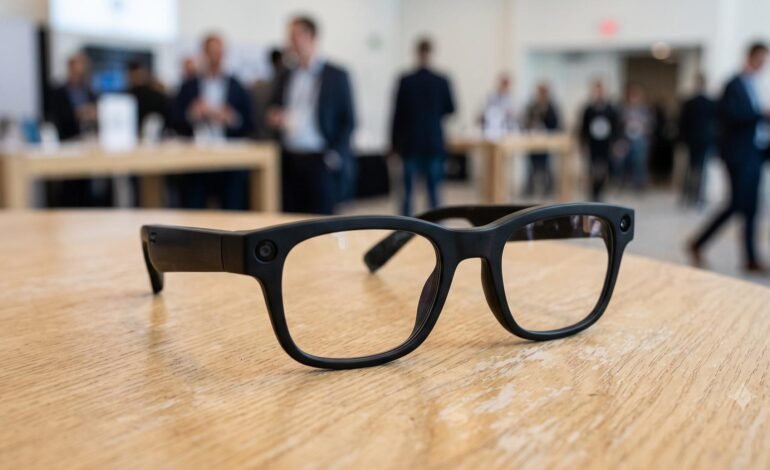
Samsung Electronics detailed its initial entry into the consumer smart glasses market during its Galaxy Unpacked event in London last week. The company’s upcoming “intelligent eyewear” relies on audio feedback and integrated cameras rather than physical displays, prioritizing a traditional aesthetic over augmented reality visual overlays.
Built on Google’s newly introduced Android XR operating system, the frames represent a collaborative effort between Samsung, Google, and chipmaker Qualcomm. The product launch signals a clear attempt by the South Korean technology manufacturer to establish face-worn computing as a primary mobile interface alongside the smartphone.
The devices will reach select markets this fall, though Samsung has not yet disclosed official pricing or the final product name.
By launching a display-free model first, Samsung is addressing what it views as the primary barrier to mainstream adoption for wearable technology: social friction. Past attempts at consumer smart glasses often stalled because the hardware looked conspicuously like recording equipment or featured bulky visual components.
“Before talking about what technology or AI is inside the glasses, our goal was to make a pair of glasses that people would want to wear the moment they saw them,” said Choi Jae-in, head of Samsung’s XR R&D team, during a press briefing in London.
To achieve a natural look, Samsung partnered with global eyewear brands Gentle Monster and Warby Parker. The resulting frames feature slim profiles and standard silhouettes, masking the computing hardware housed within the device’s arms.
Engineering and Hardware Tradeoffs
Shipping the device without an integrated display represents the most consequential engineering decision in the product’s development. Incorporating a display requires heavy optical engines, increases thermal output against the wearer’s face, and adds visual bulk that undercuts the goal of resembling standard glasses.
Instead, the Samsung frames utilize a built-in camera to capture visual context, feeding that information into integrated AI models. The device processes heavy computational tasks by offloading them to a paired smartphone, while the camera data is handled directly on the glasses’ internal chipset.
Powering the wearable is Qualcomm’s Snapdragon AR platform, optimized for power efficiency and heat management within a restricted physical space. This architecture allows Samsung to claim up to nine hours of battery life on a single charge under heavy use, including continuous video streaming and active AI processing. The accompanying charging case holds an additional seven full charges. If accurate in real-world testing, the battery performance edges out the roughly eight-hour span currently offered by competing products like the Ray-Ban Meta smart glasses.
Developing the hardware required Samsung to secure approximately 200 new patents. These include an ultraslim hinge capable of transmitting electrical signals between the front of the frame and the temples, a specialized internal structure for weight distribution, and durable speakers designed to withstand repeated exposure to facial cosmetics and sunscreen.
Android XR and Gemini Integration
The glasses operate on Android XR, a specific branch of Google’s mobile operating system built entirely for wearable computing. This software layer allows the glasses to integrate deeply with Google’s Gemini AI, granting the assistant access to real-time visual and audio data from the user’s environment.
“Google and Samsung have a shared vision to bring helpful and context-aware intelligence into everyday life,” said Sameer Samat, President of the Android Ecosystem at Google. He noted that the platform blends hardware design with assistance that “naturally responds to what you see.”
Users can interact with the glasses via voice commands, touch controls on the frame, or gesture interactions when paired with compatible devices like the Galaxy Watch. Practical applications demonstrated by Samsung include summarizing lengthy text messages, reading physical signs aloud, and performing live translation during face-to-face conversations.
While the eyewear operates within the broader Android and iOS ecosystems, Samsung heavily incentivizes its own hardware ecosystem. Galaxy smartphone owners receive deeper integration, including synchronized controls across smartwatches, Galaxy Buds, and the Samsung Health application.
Market Pressures and Competition
Samsung’s entry into the category coincides with a sudden acceleration in the smart glasses market, driven largely by advancements in generative AI. Global shipments of AI-equipped glasses reached 8.7 million units in 2025, representing a 322% year-over-year increase. Industry tracker Omdia projects shipments will surpass 15 million units by the end of 2026.
The specific sub-category Samsung chose for its debut—display-free smart glasses—is currently the industry’s fastest-growing segment. According to IDC, shipments of display-free models surged 167% in the first quarter of 2026 alone.
Much of this growth stems from the unexpected success of Meta’s partnership with EssilorLuxottica for the Ray-Ban Meta smart glasses, which proved that consumers are willing to wear camera-equipped frames if the design is socially acceptable. By partnering with Gentle Monster and Warby Parker, Samsung is attempting to replicate that fashion-forward formula while utilizing Google’s software ecosystem to counter Meta’s proprietary AI models.
Samsung executives have indicated that models featuring actual visual displays are currently in active development. However, the company will not release them until the optical technology matures enough to fit within standard-looking frames without compromising battery life or comfort.
Privacy Pledges and Workplace Friction
As camera-equipped glasses become visually indistinguishable from standard eyewear, they introduce complex privacy and security concerns. The friction of covert recording drops significantly when a user no longer has to physically raise a smartphone to capture an image.
Samsung has implemented hardware safeguards to address these concerns ahead of the fall launch. The glasses feature an exterior LED indicator that illuminates during recording. If a user attempts to obscure or cover the LED light with tape, the device’s hardware will automatically block the recording function.
On the software side, Samsung issued a public pledge stating the company will not use customer audio, video, or screen-sharing data to train its foundational AI models.
Despite these consumer protections, the proliferation of inconspicuous recording devices presents an immediate challenge for corporate IT departments. In hybrid work environments, enforcing device bans is virtually impossible, as security administrators have no practical method for determining if an employee is wearing standard glasses or a recording device on a video call.
Security analysts suggest that blanket bans on wearables in the workplace are largely unworkable. Instead, organizations will likely need to adopt tiered security policies, banning the devices outright in research laboratories and boardrooms while relying on updated acceptable-use policies for general office environments.
As Samsung finalizes the software and prepares for retail distribution later this year, the success of the initiative will test whether the Android XR platform can effectively challenge Meta’s early dominance in face-worn computing.