China Is Building an AI Film Industry: How Generative Video Could Change Movies

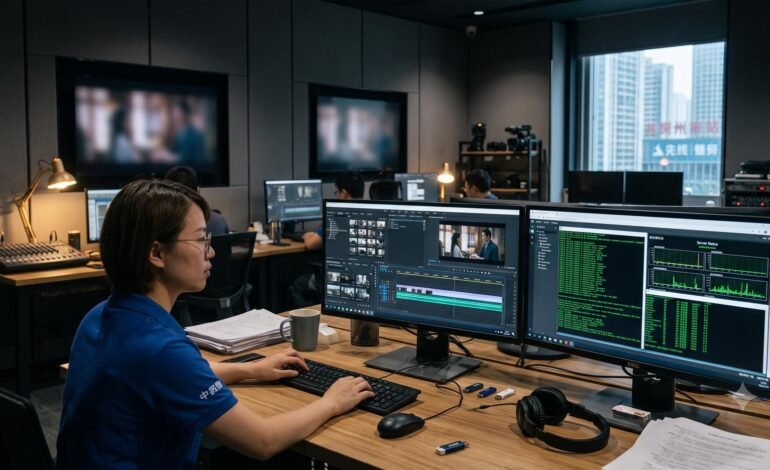
Cities across China are racing to attract artificial intelligence film studios as generative video moves from experimental novelty to commercial production.
Filmmakers, streaming platforms, and technology companies are building a new domestic industry around AI-generated content. Instead of treating AI merely as a post-production tool, Chinese entertainment hubs are backing complete workflows that rely on AI for script development, storyboarding, and direct video generation.
The push is heavily supported by regional governments. Zhu Zhili, an AI filmmaker and head of the AI-Generated Content department at China Wit Media, recently noted that officials from cities and industrial parks across the country are actively courting AI film businesses.
These municipalities are offering subsidies, computing support, and discounted rent to attract startups. The goal is to establish localized technology clusters that blend China’s existing film and animation sectors with emerging generative AI capabilities.
The Subsidized Race for AI Studios
The municipal competition highlights how seriously local governments are taking the commercial potential of generative video.
Shenzhen emerged as an early hub, providing technical support for visual effects alongside subsidized office space for production companies. Other major cities have quickly followed. In May 2026, Shanghai introduced specific measures to accelerate the production of AI-powered micro-dramas, offering studios direct access to computing power and cloud-based AI models.
Beijing has taken a similar approach. The capital established a 260 million yuan ($35 million) fund dedicated to supporting audiovisual technology. Within Beijing, the Huairou district—already known as a traditional film production center—is now offering computing-cost vouchers specifically for producers of short AI dramas.
This localized support structures the industry differently than in the United States, where AI video development has largely been driven by venture-backed technology companies like OpenAI and Runway rather than municipal industrial policy. In China, government incentives are directly bridging the gap between AI developers and the creative professionals who use their tools.
The Economics of the Micro-Drama Boom
The rapid adoption of generative video is driven primarily by a collapse in production costs.
According to China’s state broadcaster CCTV, the cost of producing AI short dramas dropped from roughly 5,000 yuan ($747) per minute to just a few hundred yuan per minute during the first half of 2026.
This dramatic reduction in overhead has triggered a surge in content creation, particularly in the highly popular “micro-drama” format—vertical, serialized video shows designed for smartphone viewing. Data from research firm DataEye, cited by Reuters, shows that 221,900 new AI shows were launched on Douyin, China’s version of TikTok, during the first six months of 2026.
However, volume has not guaranteed success. Of the hundreds of thousands of shows released, only 1,055 programs managed to attract more than 100 million views, the benchmark industry analysts use to indicate strong audience engagement.
The low barrier to entry has led to market saturation. With anyone able to produce a micro-drama at a fraction of historical costs, audiences are sifting through a massive volume of low-quality, derivative content.
Big Tech and Traditional Studios Buy In
Major Chinese entertainment and technology companies are increasingly integrating these workflows into their core business models.
In August 2026, Gong Yu, the CEO of the major streaming platform iQIYI, announced the company was going “all-in” on artificial intelligence. The streaming giant is now offering direct financial subsidies to creators who distribute AI-generated content on its platform. Earlier in the year, iQIYI launched Nadou Pro, a specialized AI agent designed for professional film and television production. The software supports the entire production pipeline, from initial script development through final generation.
Traditional film studios are also crossing the threshold into fully AI-generated theatrical releases. Bona Film Group, one of China’s largest film production and distribution companies, recently completed “Sanxingdui: Future Memories”. The 90-minute science-fiction feature was produced entirely using AI.
Crucially, China’s National Film Administration granted the movie a public-screening license, clearing it for theatrical release later this year. The regulatory approval signals that the state views AI-generated features as a legitimate part of the traditional cinema ecosystem.
Labor Concerns and Consumer Backlash
The rapid industrialization of AI video has generated significant friction among creative professionals and audiences.
Actors and voice artists are raising alarms about job security and the unauthorized use of their likenesses in AI-generated films. Because generative models are trained on vast datasets of existing media, the line between inspiration and replication remains contested.
Consumers have also voiced frustration. Viewers frequently complain about plagiarism, noting that AI creators often lift distinct elements from human artists. “Some people directly blend other people’s original characters or dance clips into AI-generated content without any credit,” Wen, a 22-year-old consumer of AI content, told Reuters. “I think that behavior is completely unacceptable.”
There are signs of audience fatigue with artificial media. Industry observers noted that the recent box-office success of “Niu Lai,” a crudely animated but conventionally produced film, was driven in part by consumer backlash against the flood of AI-generated content. The film’s human imperfections served as a selling point.
A Developing Regulatory Framework
As the industry scales, it is operating in a legal gray area regarding intellectual property.
Current Chinese regulations require explicit and visible labeling of all AI-generated content to prevent deception. However, the government has yet to establish clear copyright rules governing the material.
This regulatory lag leaves critical questions unanswered. It is currently unclear who holds the copyright to an AI-generated film, how the creators of the original training data should be compensated, and what rights individuals have when their performances or physical likenesses are incorporated into a generated video.
Despite the domestic legal uncertainty, Chinese AI filmmakers are beginning to test international markets. Earlier this year, director Cao Yiwen premiered an AI-animated film at the World AI Film Festival in Cannes.
“France and the rest of Europe are still watching and waiting to see whether China will introduce clear laws,” Cao said. “We fell behind in the first two industrial revolutions, so perhaps this is the Third Industrial Revolution.”
As local governments continue to fund AI industrial parks, the tension between rapid technological scaling and the need for clear copyright protections will dictate whether China’s generative video sector can stabilize into a mature, globally competitive film industry.