AWS Complete Guide 2026: Architecting for the AI-Native Era

Amanda Shelton
- September 23, 2026
- 7 min read
Amazon Web Services (AWS) hasn’t just maintained its lead in 2026; it has fundamentally rewired its core architecture. Sitting on a 30% share of the global cloud infrastructure market and generating a massive $128.7 billion in annual net sales, the platform has evolved from a utility provider for storage and compute into the definitive engine room for enterprise artificial intelligence.
Table of Contents
ToggleIf you are an architect, CTO, or lead engineer, the AWS of 2026 looks significantly different from the platform you were building on just two years ago. We are seeing a hard pivot away from “bring-your-own-glue” architectures toward fully managed, AI-native infrastructure.
Here is the complete guide to understanding, navigating, and building on AWS in 2026.
The State of AWS in 2026: By the Numbers
Before getting into the technical weeds, it helps to understand the scale at which AWS is currently operating. The numbers tell a story of an industry accelerating rapidly, primarily driven by generative AI adoption.
Market Share: AWS holds 28-30% of the enterprise cloud spending market, fending off aggressive pushes from Microsoft Azure (21%) and Google Cloud (14%).
Revenue: A $169 billion annualized revenue run rate as of Q2 2026.
CapEx: Amazon increased its 2026 capital expenditure guidance to $220 billion, almost entirely to expand AI and cloud infrastructure capacity.
Growth Vector: GenAI-specific cloud services on AWS are growing at a staggering 165% year over year.
This financial footprint isn’t just trivia; it dictates AWS’s product roadmap. The focus is squarely on high-capacity infrastructure for evolving AI workloads.
Silicon Is the New Software: Graviton5 and Trainium3
The most significant shift in cloud computing right now is happening at the silicon level. AWS recognized years ago that relying entirely on third-party chipmakers was a bottleneck for scale and cost-efficiency. In 2026, their custom silicon strategy has matured into a massive competitive advantage.
Trainium3 and UltraServers
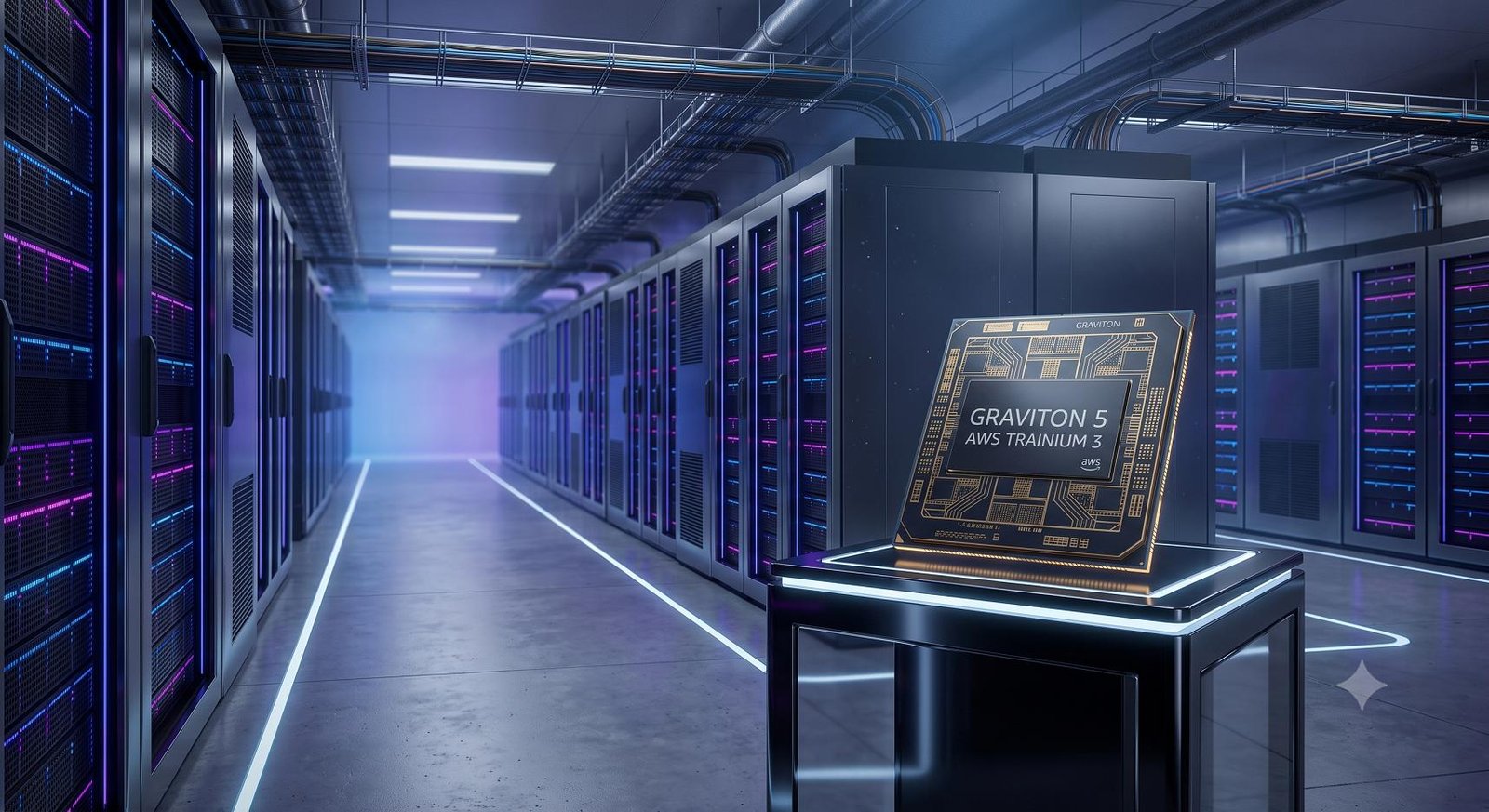
Announced at re:Invent 2025, the Trainium3 UltraServers represent a massive leap in AI training capabilities. Built on a 3nm process, these chips are designed specifically for frontier-scale model training and high-throughput inference.
When you need to train ultra-large models without bankrupting your IT budget, Trainium3 offers double the performance of the previous generation while being 40% more energy-efficient.
Graviton5
For general-purpose compute, Graviton5 is now generally available. It delivers up to 25% better performance than Graviton4, which itself offered a massive leap over the Graviton3 generation. Companies are routinely seeing compute cost reductions of over 40% simply by migrating standard workloads to Graviton-based instances.
AWS Compute Options Comparison
| Instance Family | Workload Type | Performance Jump | Cost Efficiency |
|---|
The Bedrock Evolution and Agentic AI
If 2024 was about large language models (LLMs), 2026 is about agents. AWS has positioned Amazon Bedrock not just as an API gateway to third-party models, but as an orchestration engine for complex, multi-step workflows.
Amazon Nova and Frontier Models
AWS’s native Nova models have matured rapidly. We now have distinct tiers:
Nova Micro: Text-only, built for extreme low-latency tasks.
Nova Lite: Handles text, images, and video quickly.
Nova Pro: The workhorse for multi-modal tasks.
Nova Premier: Designed for complex reasoning and enterprise-specific custom model training.
These models now support context windows expanding to 2 million tokens, making it possible to drop entire codebases or libraries of corporate documentation into a single prompt.
AgentCore and Multi-Agent Collaboration
The standout feature is Bedrock’s AgentCore. This isn’t a simple chatbot interface; it’s a framework where “Supervisor Agents” manage dozens of task-specific sub-agents.
Imagine a scenario where an incident occurs in your infrastructure. A Supervisor Agent triggers a logging agent to pull CloudWatch data, an analysis agent to identify the root cause, and a remediation agent to propose a fix—all working in parallel and resolving conflicts seamlessly. This is the reality of AWS development in 2026.
AWS AI & Compute Milestones
Data, Databases, and Serverless Reliability
You can’t do AI without data, and AWS has spent the last year removing friction from data movement and storage.
S3 Native Vectors
S3 now supports native vector operations. You no longer need to stitch together separate database services just to store and search embeddings. This drastically simplifies architecture for Retrieval-Augmented Generation (RAG) applications and reduces data duplication across your stack.
Aurora DSQL
Aurora D-Seq (Distributed SQL) has become the gold standard for global, multi-region architectures. Offering 5-nines availability, serverless scalability, and low-latency global transactions, it routinely benchmarks faster than competing options like Google Spanner.
Durable Serverless Functions
A long-standing pain point with AWS Lambda was the 15-minute timeout. With the introduction of durable functions and Managed Instances, AWS now enables long-running, stateful workflows in serverless environments. This is crucial for AI workflows that require extensive data processing or waiting on API calls without forcing teams to redesign architectures around Step Functions for simple tasks.
The End of the Cloud Wars: AWS Interconnect
Perhaps the most surprising shift has been AWS’s approach to multi-cloud. After years of walled gardens, AWS introduced AWS Interconnect.
This suite of networking tools eliminates the historical pain of routing traffic between AWS, Google Cloud, and Azure. It allows enterprise teams to combine services from different clouds without complex workarounds or fragile IPsec VPN tunnels. This acknowledgment that the enterprise future is multi-cloud is a massive win for architectural flexibility.
Best Practices for AWS in 2026
If you are deploying new workloads this year, standard practices have shifted:
Default to Graviton: Unless you have a specific x86 dependency, Graviton5 should be your default compute choice. The cost-to-performance ratio is too good to ignore.
Consolidate Vector Data: Re-evaluate your RAG architectures. Moving vector storage back into native S3 or Aurora capabilities can reduce complexity and cost.
Embrace Agentic Workflows: Start exploring Bedrock AgentCore for internal tooling. Automating the detective work of site reliability engineers or customer support teams yields immediate ROI.
Leverage SageMaker Lakehouse: Unify your data lakes and warehouses. Keeping a single copy of data for both analytics and ML training drastically reduces governance headaches.
The Future Outlook
The trajectory of AWS is clear: the underlying infrastructure is becoming invisible, replaced by high-level, AI-driven primitives. We are moving from configuring servers and networking rules to orchestrating fleets of specialized AI agents.
The organizations that win on AWS in 2026 won’t be those with the best bash scripts; they will be the ones that effectively leverage customized silicon and agentic frameworks to turn their proprietary data into actionable intelligence.