Samsung Tri-Fold Phone Future: Everything We Know

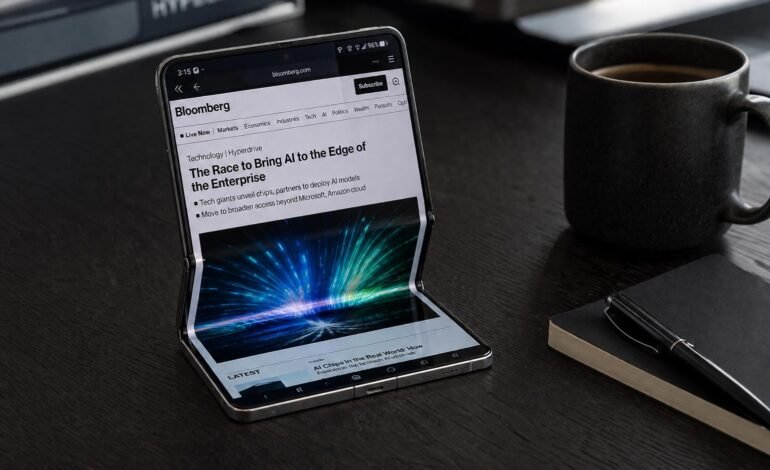
In late 2025, Samsung Electronics answered years of industry speculation by releasing the Galaxy Z TriFold, an ambitious device featuring two hinges and three display panels. The launch represented a significant hardware milestone for the mobile sector, pushing flexible screen technology to its absolute physical limits. Yet, months after its commercial debut, the narrative surrounding Samsung’s triple-folding smartphone has become complicated. Between reports of underwhelming sales, consumer pushback against its physical footprint, and supply chain rumors of a redesigned successor, the tri-fold segment remains highly volatile. Here is a comprehensive look at what Samsung accomplished with its first double-hinged device, the market forces shaping its reception, and what internal leaks suggest about the company’s future hardware strategy.
Background: The Road to the Triple Fold
The foundation for the Galaxy Z TriFold was laid long before its retail debut. Samsung Display, the conglomerate’s screen manufacturing arm, spent years publicizing flexible OLED panels capable of bending in multiple directions. At the Consumer Electronics Show (CES) in 2022, the company showcased two distinct prototypes: the Flex S, which folded in a zigzag pattern, and the Flex G, which folded inward to protect the screen. These concepts signaled Samsung’s intent to move beyond the single-hinge book style that defined the standard Galaxy Z Fold line.
For the next three years, the industry tracked a trail of patent filings indicating that Samsung was attempting to commercialize the dual-hinge design. The engineering hurdles were immense. A triple-folding device required managing thermal dissipation across separate housing segments, routing delicate internal cabling through two points of mechanical stress, and developing a battery system that could span the device without throwing off its weight distribution. When Samsung officially confirmed the device during its January 2025 product roadmap presentation, it became clear the company had finalized a workable consumer model. By December 2025, the Galaxy Z TriFold arrived in South Korea, marking Samsung’s official entry into the ultra-premium multi-fold tier before its broader global rollout in early 2026.
Key Developments: Inside the Galaxy Z TriFold
When the Galaxy Z TriFold reached the United States in January 2026, it commanded a retail price of $2,899, positioning it firmly at the top of the consumer mobile market. The hardware specifications reflected this premium positioning. Unfolded, the device reveals a massive 10.0-inch Dynamic LTPO AMOLED 2X display with a 4:3 aspect ratio and a 1584 by 2160 pixel resolution. This effectively gives users a screen size directly comparable to an entry-level iPad, packaged within a chassis that can collapse into a traditional, albeit thick, smartphone form factor.
To achieve this, Samsung engineered individual panels measuring just 3.9 millimeters at their thinnest point. When fully closed, the device measures 12.9 millimeters in thickness, placing it in line with earlier generation single-fold devices. The mechanical integrity relies on dual titanium hinges and an advanced Armor Aluminum frame, yielding an IP48 rating for basic dust and water resistance.
Internally, the device is powered by the Qualcomm Snapdragon 8 Elite Mobile Platform, built on a 3-nanometer process, paired with 16 gigabytes of memory and up to one terabyte of storage. Samsung distributed a 5,600 milliampere-hour battery system across the three panels to maintain balance and manage heat. The camera array is equally formidable, featuring a 200-megapixel primary sensor with optical image stabilization, accompanied by a 12-megapixel ultra-wide lens and a 10-megapixel telephoto module capable of 3x optical zoom.
In addition to the raw hardware, Samsung heavily integrated its Galaxy AI suite into the Z TriFold. Features like Photo Assist and Generative Edit utilize the 10-inch canvas for precise stylus input, allowing users to modify images with desktop-class precision. The Sketch to Image function takes advantage of the expanded real estate, letting users draw rough concepts that the on-device AI renders into polished graphics. By treating the device as a portable creative workstation, Samsung justified the hardware costs with exclusive software utilities that are significantly harder to use on smaller screens.
Why It Matters: Bridging the Phone-Tablet Gap
The core value proposition of a triple-folding smartphone is consolidating three distinct devices—a phone, a small tablet, and a large-format productivity screen—into a single piece of hardware. While traditional foldables offer an 8-inch canvas that works well for reading and basic multitasking, a 10-inch screen crosses a critical threshold for enterprise users. The Z TriFold accommodates three full-sized mobile applications side by side without visual compromise.
Furthermore, the device natively supports Samsung DeX. With a Bluetooth keyboard and mouse connected, the 10-inch display functions as a viable desktop alternative for mobile professionals. This convergence addresses a long-standing criticism of high-end mobile hardware: that raw processing power frequently outpaces the utility of the screen it is attached to. By providing a 10-inch display, the Z TriFold gives the Snapdragon 8 Elite chip a canvas large enough to justify its computational capabilities.
Industry Perspective: The Battle with Huawei
Samsung did not enter the tri-fold arena entirely uncontested. In late 2024, Huawei launched the Mate XT Ultimate Design, claiming the title of the world’s first commercially available triple-folding smartphone. Huawei’s device established the basic architecture that Samsung would later refine, but it was largely confined to the Chinese domestic market and lacked native access to Google Mobile Services.
From an industry standpoint, Samsung’s entry legitimized the form factor globally. However, analysts note that the competition between the two manufacturers highlights the extreme physical constraints of current battery and display technology. While Samsung achieved a slightly more durable design with its titanium hinge and ceramic-glass fiber-reinforced polymer back, both devices face identical criticisms regarding long-term reliability and fragility. The high yield failure rate of producing 10-inch flexible OLED panels free of defects ensures that manufacturing costs will remain prohibitively high for the foreseeable future, restricting these devices to a halo product status rather than mainstream commercial drivers.
The broader mobile industry is watching the tri-fold experiment closely. For years, smartphone design has largely stagnated into uniform glass slabs. Foldables injected necessary differentiation into the market, but single-hinge sales have begun to plateau in major regions like North America and Europe. Manufacturers are actively seeking high-margin form factors. If Samsung can refine the manufacturing process and bring the price of a triple-folding device closer to the $1,800 mark over the next few generations, it could force competitors like Apple and Google to accelerate their own experimental hardware divisions. Apple has remained absent from the foldable market, relying on the iPad line to service tablet consumers. A successful tri-fold category threatens that dynamic by directly cannibalizing smaller tablet sales.
Market or Consumer Impact: A Niche at $2,899
Despite the engineering triumphs, consumer reception of the Galaxy Z TriFold has been mixed. Early adopters praised the media consumption experience and the novelty of the hardware, but practical daily usage quickly revealed friction points. The device weighs 309 grams—substantially heavier than a standard flagship smartphone like the Galaxy S26 Ultra. When carried in a pocket, the dense concentration of metal, glass, and batteries is highly noticeable.
The $2,899 entry price also created an exceptionally small addressable market. Reports emerging in mid-2026 indicate that Samsung is experiencing weak demand, with some supply chain analysts suggesting the company may taper production earlier than anticipated. While the device attracted tech enthusiasts and high-net-worth consumers, mainstream buyers remain hesitant to commit nearly three thousand dollars to a first-generation design with unproven long-term durability. The required 200,000-cycle multi-folding test provides some reassurance, but real-world variables like grit ingress and accidental drops pose a higher risk to a device with two exposed hinges.
Future Outlook: What Is Next for the Tri-Fold Series
The muted commercial performance of the first iteration has triggered conflicting reports regarding Samsung’s future in the segment. Supply chain leaks from March 2026 revealed early details about a potential “Galaxy Z TriFold 2,” suggesting that Samsung’s research and development teams are actively exploring a successor. Patents filed by the company detail an alternative hinge architecture that could result in a slightly thicker but more structurally rigid frame, aiming to reduce the crease visibility and improve drop resistance. A targeted release date of 2027 has circulated among industry analysts.
However, competing rumors suggest Samsung might pause the triple-fold program entirely. Recent reports indicate the manufacturer is heavily focused on expanding the screens of its standard book-style foldables. The upcoming Galaxy Z Fold 8 is expected to feature a much wider aspect ratio, providing a better typing experience on the cover screen and a more traditional tablet feel inside, without the mechanical complexity of a second hinge. If the wide-format Z Fold 8 successfully captures the productivity market at a lower price point, Samsung may relegate the tri-fold concept back to the research lab until components become cheaper and lighter.
Beyond the immediate successor, Samsung’s patent portfolio points to other form factors, including the long-rumored Galaxy Z Slide, which utilizes a rollable display motor. The development of rollable screens presents an alternative solution to the screen-size dilemma without the bulk of multiple hinges. The internal debate at Samsung Electronics likely centers on which technology—multi-hinge or rollable—offers the best path to mass commercialization.
Conclusion
The Samsung Galaxy Z TriFold stands as a remarkable demonstration of industrial design and supply chain execution. It proved that a double-hinged, 10-inch mobile computer could be successfully manufactured and sold to consumers globally. However, engineering capability does not automatically guarantee commercial viability. The high cost, significant weight, and complex mechanical nature of the device have prevented it from reaching broader adoption. As the industry watches to see whether Samsung will release a successor in 2027 or pivot back to traditional dual-screen form factors, the Galaxy Z TriFold remains a fascinating metric for what is physically possible in mobile hardware today.
FAQs
When was the Samsung Galaxy Z TriFold released?
The device launched in South Korea in December 2025 and became available in the United States on January 30, 2026.
How much does the Galaxy Z TriFold cost?
The retail price for the base model starts at $2,899 in the United States.
What is the screen size of the Galaxy Z TriFold?
When fully unfolded, the main internal display measures 10.0 inches diagonally. The outer cover screen measures 6.5 inches.
How thick is the phone when folded?
The device measures 12.9 millimeters in thickness when fully closed.
How much does the Galaxy Z TriFold weigh?
The smartphone weighs 309 grams, making it heavier than most traditional flagship devices.
What processor powers the Galaxy Z TriFold?
It utilizes the Qualcomm Snapdragon 8 Elite Mobile Platform built on a 3-nanometer architecture.
Is the Galaxy Z TriFold water-resistant?
Yes, it carries an IP48 rating, meaning it has protection against solid particles over 1mm and can withstand immersion in water up to 1.5 meters for 30 minutes.
What cameras are on the Galaxy Z TriFold?
The rear array features a 200MP main camera with OIS, a 12MP ultra-wide lens, and a 10MP telephoto lens with 3x optical zoom. It also features two 10MP selfie cameras.
Does the device support Samsung DeX?
Yes, the large 10-inch screen natively supports Samsung DeX for a desktop-like user experience.
Will there be a Galaxy Z TriFold 2?
While Samsung has filed patents for a second-generation hinge design tentatively aimed at 2027, recent reports suggest the company is weighing consumer demand before finalizing mass production plans.