Explain the structure of an essay

An essay is an academic paper that every student has to write as a part of their academic journey. An essay is basically divided into three parts: an introduction that states your topic, a main body which contains your in-depth analysis, and a conclusion that wraps up your whole study. The most difficult part of writing an essay is organising information in body paragraphs, and that is what students find challenging while writing an essay. Well, students always form their body paragraphs in different ways. They structure it professionally and ensure that their argumentative statements can be easily understood.
To produce an essay, students need to follow a process that includes planning, researching, writing, editing, and revising. It is considered an essential component of the degree that you are pursuing. It is time-consuming and takes a lot of effort. College students find it challenging due to a hectic schedule and seek assistance from essay writing help services. Learning how to structure an essay can help you improve your writing and communication skills. So let us take a deep dive.
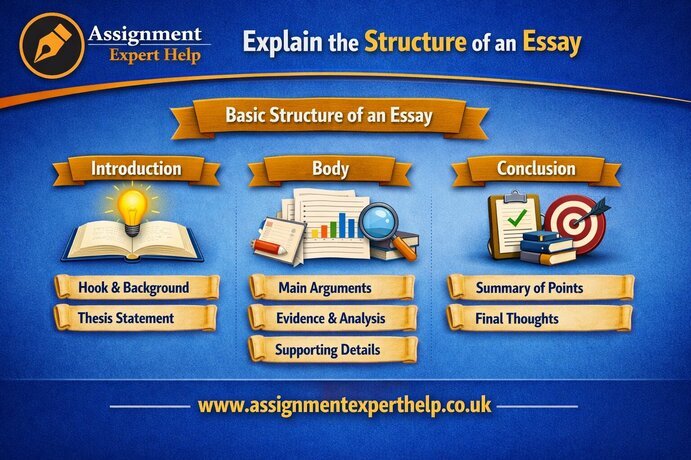
Basic structure of an essay
A standard essay is structured in three main sections including an introduction, main body, and a conclusion. It aims at providing clear, structured, logical, and evidence-based arguments. There are two things that every essay writer must keep in mind while structuring an essay. First, you should add accurate information to each section, and you must decide how you are going to organise this information into body paragraphs. Remember that an essay structure works as an outline for presenting your argumentative statements and organising your information. Let’s discuss them one by one in a brief.
An introduction: The introduction is the first paragraph of an essay that is written to present your topic, give your paper a solid background, and end with a strong thesis statement. It is written in approx 150-200 words and consists of a hook that captures the reader’s attention. It provides readers with background information and the main objective of the topic.
Body Paragraph: Body paragraphs contain the main information that is written to support your arguments. It presents your data analysis and pieces of evidence. Ensure that you add one main point to each body paragraph, starting with the topic, and relate it to the thesis statement. This section is written in approx 70 to 810 % of the length and covers the in-depth analysis that you did, focusing on a specific idea that supports the thesis. The main body includes topic sentences, an explanation of the point, support for the arguments with data, and a connection to the thesis.
Conclusion: This part of your essay summarises your whole paper, ties every point of argument together, and shows that your argument matters. This must be written in approx 100-150 words, it rephrases the main argument of your essay shortly and offers a concluding and forward-looking statement.
Wrapping it up
In conclusion, now you know how to structure your essay. Well, there are a lot more structures that might suit your essay, but these are the most commonly used. The chronological one is most commonly used in expository English essay writing, which usually explains the history of the subject and topic. So, as you know, all the structures that can be used in your next essay paper, now is the time to follow all the above-mentioned tips to craft your most compelling essay, and you can also seek assignment help services to gain new learnings and structure your essays perfectly. So get professional help and excel in your essay journey.