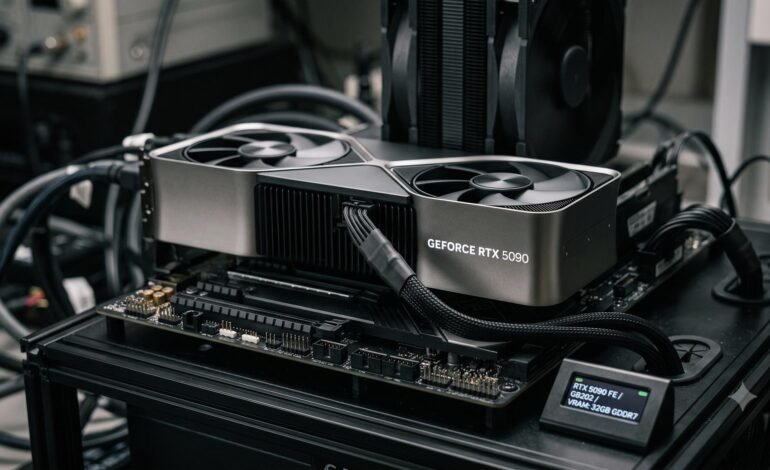
NVIDIA officially launched DLSS 5 today, bringing its latest artificial intelligence graphics technology to the PC gaming market. The update debuts alongside the release of 2K’s NBA 2K27 and is restricted exclusively to NVIDIA’s RTX 50-series desktop and laptop graphics cards.
The release marks a notable shift in how NVIDIA applies AI to rendering. While earlier iterations like DLSS 3 and DLSS 4 focused primarily on performance—using AI to upscale resolution and generate intermediate frames to increase frame rates—DLSS 5 aims to improve visual quality.
According to NVIDIA, the new software introduces 3D-Guided Neural Rendering. This technology analyzes a game engine’s finished frame and motion vectors, then uses a localized AI model to add intricate lighting and material details that developers typically reduce or remove to maintain smooth performance.
A Different Approach to Neural Rendering
When CEO Jensen Huang announced the technology in March, he described it as a way to blend traditional rendering with generative AI. In practice, DLSS 5 focuses on realism in specific materials. It calculates how light scatters underneath human skin, how it passes through foliage and hair, and produces more accurate contact shadows.
The integration in NBA 2K27 highlights this specific use case. Developer Visual Concepts relies on detailed scans of real athletes, meaning facial geometry and proportions must remain exact to avoid an unnatural appearance. DLSS 5 operates around these constraints by leaving the underlying character models untouched while altering the surrounding lighting environment.
For instance, the technology corrects how arena lighting warms a player’s skin and sharpens the shadow definition cast by clothing elements like jersey collars and compression sleeves. Developers can control these effects using new tools within the software, applying masks so the AI enhances the background environment while preserving character details.
Players can activate DLSS 5 dynamically during gameplay with a single toggle, provided they have installed the September 3 Game Ready Driver.
The Evolution of DLSS
When NVIDIA introduced the first version of Deep Learning Super Sampling in 2018 alongside the RTX 20-series, the goal was simple: offset the massive performance cost of early ray tracing. DLSS 1 and 2 utilized trained neural networks to upscale lower-resolution images to match native 4K, giving players a framerate boost with minimal loss in image quality.
By the time DLSS 3 and DLSS 4 arrived, the company shifted toward frame generation. Using motion vectors and optical flow accelerators, the AI began predicting and generating entirely new frames between traditionally rendered ones. These updates were focused strictly on motion and speed—solving the problem of demanding game engines running poorly on consumer hardware.
DLSS 5 pivots from this established path. Instead of focusing on generating pixels to inflate frame rates, the new 3D-Guided Neural Rendering model is designed to reintroduce detail that game studios typically have to cut during development to keep their games playable in real time.
How 3D-Guided Neural Rendering Works
In modern game development, studios rely heavily on baking lighting and shadows into an environment to save computational power. Real-time rendering pipelines often struggle with complex light behavior, such as subsurface scattering—the way light penetrates a surface and diffuses underneath.
According to technical documents released by NVIDIA, DLSS 5 addresses this by analyzing the engine’s final output frame along with its corresponding motion vectors. It then applies a localized AI model to calculate and insert these complex lighting interactions before the frame reaches the player’s monitor.
This allows the AI to add realistic light scattering, more accurate global illumination, and precise contact shadows—the dark spaces where two objects meet, which are notoriously difficult for traditional game engines to render correctly.
For developers, the integration relies on the existing NVIDIA Streamline framework and an Unreal Engine 5 plugin, meaning studios do not need to overhaul their rendering pipelines to support the new features. Furthermore, creators retain artistic control. The tools include structural and tone intensity sliders, as well as semantic masking, enabling artists to dictate exactly where the AI should intervene and where it should leave original textures alone.
The Hardware Divide and Modding Controversy
While the technology offers clear visual benefits, its rollout has sparked debate across hardware forums and PC gaming communities. The core of the frustration stems from NVIDIA’s decision to lock DLSS 5 exclusively to the GeForce RTX 50-series, which uses the new Blackwell architecture.
During a technical briefing at the Gamescom trade fair last month, NVIDIA representatives told reporters that older hardware would not receive support. The company maintained that the AI model relies on Blackwell’s fifth-generation Tensor cores and that no fallback path exists for the Ada Lovelace architecture used in the RTX 40-series.
That narrative was challenged just days before launch. An early version of NBA 2K27 leaked online, containing the DLSS 5 dynamic link library (DLL) file. Modders extracted the file, patched the CUDA binaries designed specifically for Blackwell, and successfully ran the neural rendering model on RTX 40-series graphics cards.
The unofficial modification proved that the technology is not strictly tied to the newest hardware, though it highlighted why NVIDIA may have hesitated to support older cards. When running on an RTX 4090—the flagship card of the previous generation—the unoptimized software exacted a massive performance toll. In testing with modified versions of the game Control, frame rates plunged from 135 fps down to 82 fps when Neural Rendering was enabled, representing a performance penalty of nearly 40 percent.
Critics argue that NVIDIA should officially support the RTX 40-series, even with the performance hit, rather than relying on an artificial software lock. Modders are expected to continue refining their workarounds, creating a scenario where players modify drivers to access features the hardware manufacturer refuses to support natively.
NVIDIA has not indicated any plans to change its stance. The company argues that officially releasing an unoptimized feature risks breaking millions of active driver installations, opting instead to limit the technology to hardware that can run it without severely degrading performance.
Performance Benchmarks and Availability
For players who have upgraded to the RTX 50-series, the performance metrics are high. When running NBA 2K27 at 4K resolution on the ultra preset with ray tracing enabled, an RTX 5090 paired with DLSS 5 produces up to 370 frames per second. The mid-range RTX 5070 maintains smooth performance as well, achieving 260 fps at 1440p resolution.
The efficiency marks a significant improvement from the technology’s initial development phases. According to NVIDIA, the computational cost of the 3D-Guided Neural Rendering model was reduced fivefold over the past six months. Early versions of the software reportedly required the processing power of two flagship RTX 5090 cards to function in real time.
DLSS 5 goes live today at 9 p.m. Pacific Time. To access the feature in NBA 2K27, players must download and install the new Game Ready Driver releasing concurrently. In-game, the neural rendering feature acts as a simple toggle, which players can turn on or off mid-game by pressing the F9 key.
The launch also extends beyond local hardware. Subscribers to NVIDIA’s GeForce NOW Ultimate cloud gaming service will have immediate access to DLSS 5, as the platform’s high-end remote servers are powered by RTX 5080 systems.
NVIDIA plans to release additional optimizations for DLSS 5 later this fall, with more game developers expected to announce support for the technology in the coming months.