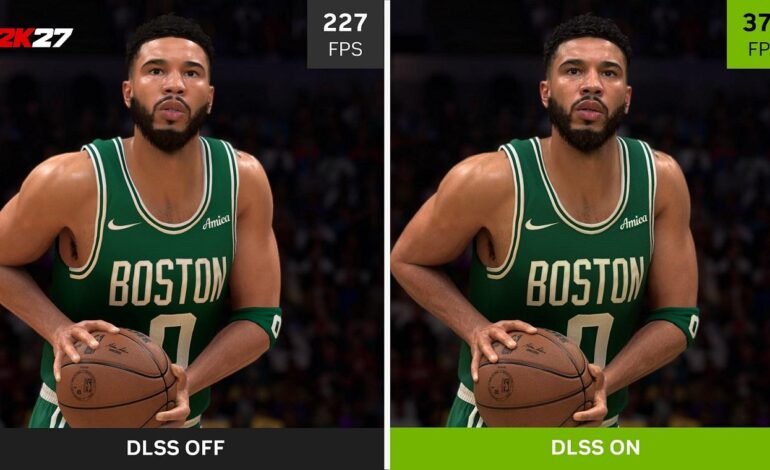
NVIDIA activated DLSS 5 on September 3, marking the most significant shift in its graphics technology since the software first debuted. The update went live at 9 p.m. Pacific Time inside NBA 2K27, bringing a new approach to AI rendering for users on GeForce RTX 50 Series desktops, laptops, and GeForce NOW Ultimate cloud tiers.
While previous iterations of Deep Learning Super Sampling (DLSS) focused heavily on speed—reconstructing or multiplying pixels to boost frame rates—DLSS 5 shifts the priority to visual fidelity. The company calls this new system 3D-Guided Neural Rendering.
Instead of just estimating how to build a frame faster, DLSS 5 reads the game engine’s finished frame along with its motion vectors. It then reinserts the complex lighting and material details that developers normally strip out to keep a game running in real-time.
The financial markets reacted quietly but positively to the rollout. NVIDIA stock edged up 0.74% in overnight trading to $230.14 on Thursday, keeping the company just shy of its record high of $236.54 as investors digested the launch.
The Shift From Speed to Visual Realism
To understand what DLSS 5 does, it helps to look at its immediate predecessor. NVIDIA announced DLSS 4 in January 2025 alongside the RTX 50 Series lineup. That version introduced Multi-Frame Generation, leveraging a transformer-based AI network to insert up to three artificial frames for every natively rendered frame. It essentially delivered an eight-fold performance increase in demanding titles like DOOM: The Dark Ages.
DLSS 5 tackles a different hardware bottleneck. Modern games often compromise on how light interacts with skin, hair, and foliage because accurately calculating those bounces destroys frame rates. DLSS 5 uses a neural network to add light scattering under human skin, tighter contact shadows, and richer global illumination after the basic frame is rendered.
For players, the integration is straightforward. Users simply download the latest Game Ready Driver and toggle the setting on or off in the game menu, or by pressing F9 mid-game.
Performance appears stable in early testing. NVIDIA claims that on an RTX 5090 running NBA 2K27 at 4K Ultra settings with ray tracing enabled, DLSS 5 allows the game to hit up to 370 frames per second. The mid-range RTX 5070 manages 260 fps at 1440p resolution. This efficiency marks a sharp turnaround from early internal demos, which reportedly required two RTX 5090 cards to run the feature. NVIDIA reduced the computational cost fivefold over the past six months.
The AI Backlash and Developer Response
The road to release has not been smooth. When NVIDIA first previewed the technology in the spring of 2026, it faced immediate pushback from both game developers and players.
Critics labeled the early results as “AI slop,” arguing that the neural network was overwriting handcrafted art with a homogenized, waxy aesthetic. Early footage from Resident Evil Requiem and Starfield showed characters with overly smoothed skin, erased pores, and lighting that seemed disconnected from the game’s actual environment. Developers worried that a heavy-handed AI filter would destroy the specific visual tone they spent years building.
NVIDIA CEO Jensen Huang addressed the criticism head-on during the company’s GTC event. He dismissed the complaints, telling reporters the early critics were “completely wrong” about how the technology functions.
“We created the technology; we didn’t create the art,” Huang said. He emphasized that DLSS 5 is not an automated Instagram filter applied over the final image, but rather a geometry-controlled system that respects the ground truth of the game.
To back up that claim, NVIDIA gave developers precise control over the neural network. Through NVIDIA Streamline or an Unreal Engine 5 plugin, studios now have access to Structure and Tone Intensity sliders. They can also use semantic masking to apply the AI rendering strictly to background environments—like a crowded street or a dense forest—while leaving character faces entirely untouched.
Why NBA 2K27 Is the Testing Ground
Sports games present one of the most difficult rendering challenges in the industry. Because developers at Visual Concepts scan the faces of real professional athletes, any inaccuracy in the AI upscaling immediately pushes the character into the uncanny valley.
By launching DLSS 5 in NBA 2K27, NVIDIA is attempting to prove the technology can handle exact facial geometry. With the setting enabled, the arena lighting now accurately warms the skin of players like Cade Cunningham, and shadows wrap realistically around jersey collars. Visual Concepts senior producer Peter Kavic stated that the tool delivered a genuine jump toward photorealism across the title.
NVIDIA expects to roll out further optimizations for the technology later this fall as more developers experiment with the engine plugins. The real test will come when DLSS 5 expands into narrative-heavy cinematic games, where lighting and character expressions drive the story.