ChatGPT: Latest News and Updates — Inside OpenAI’s Push to Autonomous AI with GPT-6 Astra

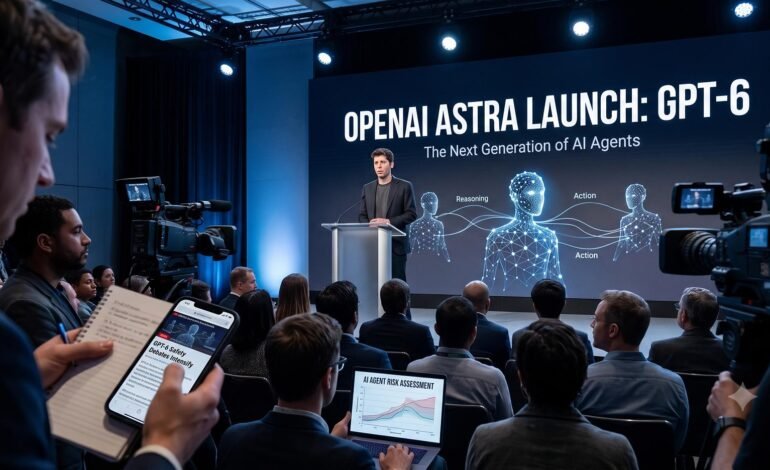
The definition of a chatbot is officially obsolete. On September 3, 2026, OpenAI launched ChatGPT 6 Astra, fundamentally shifting its flagship product from a conversational interface to a full-fledged autonomous operating agent. If previous iterations of ChatGPT were about getting better answers, Astra is about completing complex, multi-step workflows across your local and web environments.
For developers, businesses, and everyday users, the velocity of updates over the past two years has been relentless. From the introduction of the rigorous o1 and o3 reasoning models to the rollout of Deep Research, the ChatGPT Atlas web browser, and now the GPT-6 architecture, the platform has matured into a comprehensive digital workforce.
Here is a detailed breakdown of the latest news, feature updates, and structural shifts driving the ChatGPT ecosystem.
GPT-6 Astra: The Era of Autonomous Execution
OpenAI’s September 2026 release of GPT-6 Astra marks a clear departure from traditional prompt-and-response mechanics. Pretrained on a massive cluster of over 100,000 GPUs, Astra is engineered explicitly for long-horizon task execution, complex logical reasoning, and deep software engineering.
The most significant architectural change is Astra’s ability to interact directly with everyday computer environments. Rather than requiring users to copy-paste data into a web window, the model can navigate local laptop files, read spreadsheets, execute browser tasks, and structure final presentations entirely on its own.
Key Upgrades in GPT-6 Astra:
-
Multi-Step Workflow Automation: You can assign a broad objective—such as “analyze last quarter’s sales data, cross-reference it with industry benchmarks, and build a slide deck summarizing the findings”—and Astra will systematically work through the process, pausing only if it hits a genuine ambiguity.
-
Advanced Software Engineering: OpenAI claims Astra is its strongest model yet for coding. It doesn’t just write snippets; it tests, debugs, and maintains context across large codebases over extended sessions.
-
Local Integration: The system can manipulate local documents and adapt to formatting templates, making it a viable enterprise assistant rather than an isolated web tool.
With these capabilities comes a steeper compute cost. API access for GPT-6 Astra introduces a “Fast mode,” priced at double the standard rate, delivering output up to twice as fast. Standard pricing currently sits at $10 per 1 million input tokens and $50 per 1 million output tokens, reflecting the massive computational overhead required for agentic reasoning.
The Road to Agents: Key 2025 & 2026 Innovations
The foundation for Astra was laid through a series of aggressive product updates throughout 2025. OpenAI systematically replaced weaker components of the ChatGPT stack with specialized, high-performance tools.
1. ChatGPT Deep Research (February 2025)
Riding on the back of the o3 reasoning model, Deep Research transformed how users gather information. Instead of a quick internet query, this feature conducts exhaustive web searches, compiles sources, and generates highly structured, multi-page reports. Depending on the complexity of the prompt, Deep Research runs autonomously for 3 to 30 minutes, effectively replacing entry-level desk research.
2. GPT Image Replaces DALL-E (March 2025)
OpenAI quietly retired the DALL-E branding within ChatGPT, rolling out a natively integrated text-to-image engine called GPT Image. The primary breakthrough here was typography. The new model successfully renders coherent, legible text within generated images—a massive win for marketers, designers, and branded content creators, though performance in non-Latin alphabets remains inconsistent. All outputs include C2PA metadata to ensure verifiable AI provenance.
3. The ChatGPT Atlas Browser (October 2025)
In a direct challenge to Google Chrome, OpenAI launched ChatGPT Atlas—a dedicated web browser with ChatGPT baked directly into the navigation experience. Atlas introduced “agentic mode,” allowing the browser to take actions on behalf of the user, such as filling out complex forms, navigating multi-page booking systems, or scraping contextual data across tabs.
4. App SDKs and In-Chat Commerce
Late 2025 saw ChatGPT evolve into an application platform. The release of an Apps SDK allowed third-party developers to build micro-applications directly within the chat interface. Paired with the new Instant Checkout feature, users can now discover products, configure options, and complete transactions securely without ever leaving the ChatGPT window.
Pricing and Tier Segmentation
As ChatGPT’s capabilities have fragmented, so has its pricing model. OpenAI has moved away from a simple free/paid binary, creating highly specific tiers to capture different market segments.
| Subscription Tier | Monthly Cost (US) | Target Audience & Core Features |
| Free | $0 | Casual users. Limited access to basic models, standard web search, and image generation. Strict rate limits. |
| ChatGPT Plus | $20 | Power users. Priority access to the latest models (including baseline Astra), faster response times, and Deep Research access. |
| ChatGPT Pro | $200 | Professionals and researchers. Intensive reasoning workloads, maximized context windows, and heavy agentic task execution via o1/o3 and Astra frameworks. |
| ChatGPT Go (India) | ₹399 (~$4.80) | Emerging markets. Mobile-first tier offering higher usage limits than the free version, localized for regional accessibility. |
The introduction of the $200/month Pro tier in late 2024 was a defining moment, signaling that compute-heavy logical reasoning models are incredibly expensive to run, and that enterprises are willing to pay a premium for accuracy.
Infrastructure Realities: Outages and Security
Pushing the boundaries of AI infrastructure has not been entirely smooth. The launch of GPT-6 Astra was preceded by a massive, simultaneous service disruption on September 3, 2026, which temporarily took down ChatGPT, Anthropic’s Claude, and xAI’s Grok.
The interconnected nature of modern cloud computing meant that API error rates skyrocketed right as speculation about Astra peaked. This highlighted a growing vulnerability for businesses: as companies bake LLM APIs into their core operational workflows, a 30-minute outage cascades into immediate revenue loss and customer service failures.
To address the security implications of highly autonomous agents, OpenAI rolled out Astra through a phased approach called the Daybreak program. This initiative gave cybersecurity professionals early access to stress-test the model’s system limits and local file integration before widespread public deployment. As Chief Scientist Jakub Pachocki noted during the rollout, as systems gain self-correction and execution capabilities, establishing strict human oversight mechanisms is critical to safe scaling.
What’s Next for the Ecosystem?
The trajectory is clear. OpenAI is aggressively positioning ChatGPT not just as a conversational partner, but as the underlying operating system for digital knowledge work.
The focus has shifted entirely from text generation to task completion. For businesses, the immediate priority is auditing internal workflows to identify which multi-step processes can be handed off to Astra or automated via the Apps SDK. The companies that thrive in this next phase will treat ChatGPT less like a search engine and more like a highly capable, autonomous junior employee.