AI Tools vs Traditional Software: The Hidden Shift That’s Quietly Rewiring Entire Industries

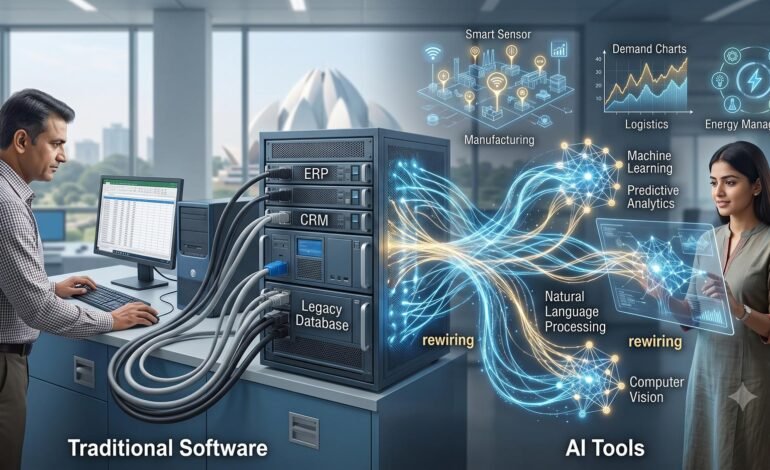
Picture the software you used ten years ago. That bulky accounting package, the customer relationship manager that crashed every Thursday afternoon, the spreadsheet that did exactly what you told it, and nothing more. Now open a modern app with predictive text, auto-generated summaries, or a strangely intuitive search that feels less like a machine and more like a very literal-minded colleague. Something fundamental has split the world of software in two, and the crack runs deeper than most workflow diagrams suggest.
When Software Starts To Think, And When It Doesn’t
Traditional code operates on a brutally simple contract: given this input, produce that output. No nuance, no second-guessing. If a user clicks button A, fire action B. The logic is deterministic, and that predictability has been the bedrock of enterprise computing for decades. Yet there is a quiet hunger for systems that bend, that adapt to messy real-world data without a developer recompiling a rules engine every time the wind changes direction. That hunger is what AI-powered tools feed.
AI-powered tools don’t just follow instructions. They shuffle probabilities, they learn from patterns, they sometimes guess, and, rather unnervingly, they guess right often enough to be useful. A traditional inventory management system will reorder stock when the quantity dips below a fixed threshold. A machine learning model might notice that sales spike before a local holiday that no human bothered to code into the system. The difference is not just intelligence; it’s a shift from rigid guardrails to a kind of soft, statistical awareness. Actually, it might be misleading to call it “awareness”; it’s more like a very well-trained reflex. But the outcome feels uncanny when you experience it for the first time.
The Unseen Friction Of Deterministic Logic
There is a reason why traditional software limitations start to chafe once you taste something more fluid. Traditional programs demand that the world be neat. They break when faced with a PDF that’s tilted two degrees, a customer email written in a dialect the parser never saw, or a sudden supply chain disruption that falls outside the “if-then” tree. You have probably wrestled with a helpdesk portal that forces your complaint into a drop-down category that doesn’t fit. That’s traditional software limitations in action, a cage built from well-meaning assumptions that aged badly.
A study by McKinsey highlighted that nearly 60% of knowledge workers spend time wrestling with data from systems that don’t talk to each other, cleaning and re-entering information (see the full McKinsey Global Survey). Those gaps are not accidental; they are the scars of deterministic logic trying to cope with an organic mess. Traditional software limitations are not always a sign of poor engineering. Often, they are a sign of correct engineering applied to an incorrect model of how people actually work. The software behaves exactly as designed. The problem is the design never accounted for the third Tuesday in November feeling different from any other day. And yet, for all that frustration, these systems keep the lights on in banking, logistics, and healthcare. The reliability is real, if suffocating.
Where The AI Software Comparison Gets Messy
An honest AI software comparison runs into trouble the moment you try to measure “better.” Better at what? At catching fraudulent transactions? Probably yes, because an AI-powered tools engine can sift through millions of events and spot a faint anomaly that no rule writer would bother to codify. Better at generating a legally airtight contract? That’s far less clear. A large language model might hallucinate a clause, and suddenly you’re liable for a promise you never intended. In that scenario, the old boilerplate generator, as dumb as it is, becomes a safety net. This is where a real AI software comparison gets sweaty and uncomfortable.
Look at customer support. A traditional ticketing system routes a complaint to a human agent based on keywords. An AI-driven assistant resolves the simpler 60% of queries on its own, leaving the hard ones for the team. That’s a tangible win. Yet the same AI software comparison flips when the AI confidently misinterprets a distressed customer and offers a cheerful “That’s great to hear!”, a failure mode that a static FAQ page would never, ever produce. AI software comparison isn’t a spreadsheet battle; it’s a trade-off between adaptability and predictable risk.
Perhaps the most loaded angle in any AI software comparison is the data hunger. Traditional software runs fine on a thin trickle of structured inputs. AI-powered tools often need a river of historical data, and if that data carries hidden biases, well, the tool will amplify them with an innocent smile. There’s an eerie example from hiring: an AI screening tool trained on a decade of resumés learned to penalize applicants who attended women’s colleges, not because anyone told it to, but because the training data reflected historical gender imbalances. A conventional keyword filter would have been dumber but also less insidiously creative.
The Real-World Bet: Trading Predictability For Adaptability
Walk into a mid-sized logistics firm that swapped its route-planning software for an AI-driven dispatcher. For years, the old system gave drivers fixed routes calculated overnight using static algorithms. It was predictable, and drivers complained about traffic jams it never foresaw. The new AI-powered tools platform ingests live traffic, weather, and delivery urgency, then reshuffles routes every fifteen minutes. Early on, chaos reigned; drivers missed turns because the app updated mid-trip. A few months in, fuel costs dropped 12%, and on-time deliveries climbed. The trade was predictable mediocrity for unpredictable excellence. The human cost, though, was real; veteran drivers felt their street knowledge was being overwritten by a black box. You might notice that AI-powered tools solve one problem and create a softer, more psychological one. That’s rarely in the brochure.
The Stubborn Strengths Of Old-School Code
For all the dazzle, traditional software still has a death grip on domains where explainability is non-negotiable. A nuclear plant’s safety system must be deterministic; no regulator will accept “the model decided it was probably fine.” In these environments, traditional software limitations can actually be a feature; they mean the system’s behavior can be exhaustively tested and certified. A bank’s core ledger doesn’t need to learn; it needs to be an unblinking, unforgiving record. Here, the AI software comparison tips heavily toward the old guard, not because AI is incapable but because the cost of a probabilistic error, however rare, is too catastrophic to entertain.
Beyond safety-critical systems, there is the quiet rebellion of users who simply prefer tools that don’t surprise them. An accountant may loathe an expense management tool that auto-categorizes purchases because it keeps assigning client lunches to “entertainment” when the tax code demands “meals.” The friction is small but constant, a thousand paper cuts that erode trust. In such contexts, traditional software limitations are actually constraints that preserve control. The user knows every rule, even the stupid ones, and can work around them. The same cannot be said for a model that changes its mind between Monday and Tuesday.
Why The Decision Rarely Feels Clean
No organization wakes up and says, “Let’s rip out all our legacy systems tomorrow.” What actually happens is a creeping hybridity. A marketing team plugs an AI software comparison tool into their email platform to optimize subject lines while the underlying database remains a creaking Oracle monolith from 2009. Operations begin to layer an AI-powered tools forecasting module atop an ERP that still thinks a punch card is a valid input. This messy coexistence is the reality you will encounter, not the neat slide deck.
That brings up an unglamorous truth: integration pain. Traditional software was often built as a self-contained island, and API layers were an afterthought. AI-powered tools thrive on data pipelines that cross silos, forcing companies to finally clean house. The human inertia is immense. People have learned to work around the old system’s quirks, they have a mental catalog of workarounds that represent years of tacit knowledge. Asking them to abandon that for a tool that doesn’t always explain its reasoning feels like a personal affront. The softer side of the AI software comparison, the emotional and cultural weight, might actually decide more projects than any technical benchmark.
And then there’s the matter of cost, which refuses to stay on any tidy ledger. Traditional licenses are expensive but predictable. Cloud-based AI-powered tools often charge per API call, and a spike in usage, say, a viral campaign, can inflate the bill overnight. Small businesses have been burned by this. A bakery that used an AI-driven ad platform saw sales jump and then watched their tool bill consume most of the new margin. That is not a software failure; it’s a business model misfire, but it stings all the same.
No matter how you slice it, the line between the two camps grows blurrier by the quarter. Vendors are stuffing machine learning into everything, even the calculator app on your phone. Traditional platforms are bolting on “smart” features that sometimes work and sometimes feel like a confused intern. In five years, the distinction may be irrelevant; every piece of software will have some AI component. For now, though, the choice feels deeply personal, a question of whether you want a tool you can trust completely or a tool that can surprise you in ways you didn’t expect.
Frequently Asked Questions
Can I run AI tools entirely offline, without an internet connection?
Some lightweight models (like certain OCR or on-device voice recognition) work offline, but most advanced AI features require cloud connectivity for heavy computation and model updates. The line is shifting, with more edge-AI chips entering laptops and phones.
Do AI tools always require huge datasets to be effective?
Not always. Transfer learning and pre-trained models let you fine-tune a system with relatively small, domain-specific data. However, for highly specialized tasks, the data hunger can be significant.
Is it harder to secure AI-driven software compared to traditional applications?
AI introduces new attack surfaces, such as data poisoning and adversarial inputs designed to fool the model. Traditional software has mature security practices, while AI security is still evolving, making it arguably riskier in sensitive contexts without proper safeguards.
Will AI tools eventually make traditional software obsolete?
Probably not entirely. Deterministic systems will remain where absolute reliability and explainability are mandated by law or safety. AI will likely become a layer that augments rather than replaces core systems.
How do I test an AI tool when its outputs aren’t predictable?
Testing shifts from verifying exact outputs to statistical validation, checking that outputs fall within acceptable accuracy ranges over many trials. It requires new QA mindsets and often continuous monitoring post-deployment.
Can small teams afford to build custom AI tools, or are they limited to off-the-shelf solutions?
With cloud AI services and low-code platforms, small teams can prototype AI features without a data science Ph.D. Custom models still require expertise, but the barrier has lowered dramatically compared to five years ago.