Intel Shares Surge on Q2 Earnings Beat and Surging AI Chip Demand

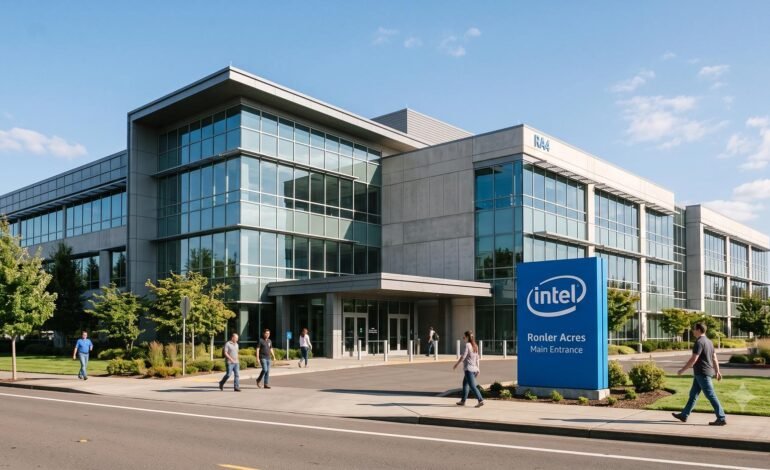
Intel reported its fastest quarterly revenue growth in more than 15 years on Thursday, sending its stock up more than 12 percent in after-hours trading. The results indicate that the company’s turnaround efforts are taking hold as it capitalizes on sustained spending in artificial intelligence infrastructure.
The U.S. semiconductor manufacturer posted second-quarter revenue of $16.13 billion, an increase of 25.4 percent from the same period a year earlier. This comfortably beat the $14.33 billion consensus estimate from Wall Street analysts.
Adjusted earnings reached 42 cents per share, doubling the 21 cents analysts had projected. Gross margin, a closely watched metric of manufacturing efficiency and pricing power, came in at 41.8 percent, surpassing the company’s own guidance by nearly 300 basis points.
The strong quarterly performance offers validation for Chief Executive Lip-Bu Tan, who took the helm following a turbulent period for the company. Tan prioritized financial discipline and execution in Intel’s contract manufacturing business, aiming to correct course after the capital-intensive restructuring strategy initiated by his predecessor, Pat Gelsinger, weighed heavily on the company’s balance sheet in recent years.
Data-Center Sales Lead the Growth
The primary catalyst for Intel’s earnings beat came from its data-center and AI operations. Revenue in this segment climbed 59 percent year-over-year to $6.26 billion, outpacing analyst estimates of $5.37 billion.
Intel is benefiting from the expanding deployment of “agentic AI,” a subfield of artificial intelligence where autonomous software agents perform complex, multi-step tasks—such as writing code or analyzing financial data—with minimal human intervention. These applications require massive computational resources, driving a resurgence in demand for traditional central processing units (CPUs) that function alongside specialized AI accelerators.
For much of the past three years, investors have focused heavily on Nvidia and Advanced Micro Devices as the primary beneficiaries of the AI hardware boom. Intel’s latest figures suggest the hardware market is broadening to include established CPU manufacturers.
“What’s going on is much bigger than Intel,” Gene Munster, managing partner at Deepwater Management, said following the report. “Results are a sign that we are still much earlier in AI than many think. I think of Intel CPUs as an accessory to the AI buildout.”
Intel management noted that demand currently exceeds the company’s ability to manufacture certain data-center CPUs. The company reported that it has signed multiple long-term supply agreements with enterprise customers for both server processors and specialized AI chips known as XPUs.
Foundry Business Secures Key Customers
A central pillar of Intel’s long-term strategy is its foundry business, which manufactures semiconductors for external clients. This segment aims to challenge Taiwan Semiconductor Manufacturing Co. (TSMC), the dominant player in contract chipmaking.
Intel Foundry generated $5.77 billion in second-quarter sales, edging past Wall Street expectations of $5.55 billion. Sequentially, the unit’s revenue increased by 6 percent from the first quarter.
The company announced a significant customer win during the quarter, securing Tesla for its next-generation 14A manufacturing process. The automotive and technology company plans to use Intel’s facilities to produce its “Terafab” AI chip, providing a high-profile endorsement of Intel’s advanced manufacturing capabilities.
Intel Chief Financial Officer David Zinsner confirmed that the 14A node is now formally targeted for both internal product groups and external foundry customers. Meanwhile, the company’s 18A manufacturing process has moved into risk production, with certain product lines shifting into high-volume manufacturing using advanced extreme ultraviolet (EUV) lithography equipment.
These manufacturing milestones are critical for Intel. The U.S. government has actively supported the company’s foundry expansion as part of a broader national policy objective to reduce reliance on semiconductor manufacturing based in Asia.
Shift in the Personal Computer Market
Intel’s client computing division, recently renamed the Client Computing and Physical AI Group, reported $8.88 billion in revenue, up 15 percent sequentially and well above estimates of $7.89 billion.
While overall unit shipments in the desktop and laptop markets declined slightly, average selling prices increased. Zinsner attributed this to a strategic shift away from supplying low-margin chips for entry-level computers. Instead, Intel is prioritizing higher-end processors designed to handle AI tasks locally on devices, rather than relying entirely on cloud servers.
The company said that over 130 hardware customers are currently testing or adopting its Core Ultra Series 3 processors for edge computing and robotics applications. This transition toward higher-priced inventory has directly contributed to the improvement in the company’s gross margins.
Boosting Capital Expenditure
To meet the accelerated demand for both AI server chips and foundry services, Intel is adjusting its investment plans.
Zinsner announced that the company will increase its capital expenditure forecast for 2026 to more than $20 billion, up from an earlier target of $18 billion. He added that capital spending is expected to increase “meaningfully” again next year.
“That’s signaling the confidence around the growth opportunities for the business,” Zinsner said. “It gives us a pretty good confidence around what we should be planning in terms of output.”
The aggressive spending strategy comes with financial risks, particularly given Intel’s recent history of tightening capital to manage its balance sheet. However, the company ended the second quarter with approximately $40 billion in total liquidity, including cash reserves, short-term investments, and an undrawn credit facility. Its operating cash flow for the quarter was a positive $7.0 billion.
While the company does not currently have a formal plan to sell additional shares to raise capital, Zinsner indicated that executives are keeping the option open depending on future manufacturing needs.
The Road Ahead for Intel
Intel’s forecast for the third quarter provided further momentum for the stock. The company projected revenue between $15.8 billion and $16.8 billion. The low end of that range sits above the $15.1 billion average analyst estimate, a rare occurrence that signals strong near-term visibility from corporate buyers.
Intel expects adjusted earnings of 38 cents per share for the September quarter, compared with the 27 cents analysts had modeled.
The positive report had an immediate ripple effect across the semiconductor sector. Shares of competitors AMD and Arm Holdings both rallied more than 3 percent in extended trading Thursday, adding more than $100 billion in combined market value alongside Intel’s gains.
In the regular trading session before the earnings release, Intel shares had closed down 2.46 percent at $100.10 amid a broader tech selloff. Following the report, the stock pushed toward $110 in after-hours and premarket trading.
While Intel’s latest results suggest the worst of its corporate restructuring may be in the rearview mirror, execution remains critical. The company must successfully scale its 18A and 14A manufacturing nodes while navigating intense competition in the data center and the external foundry market. For now, the financial results indicate that Intel has secured a position in the current AI expansion.