OpenAI Launches GPT-6 Astra Amid AI Agent Safety Concerns

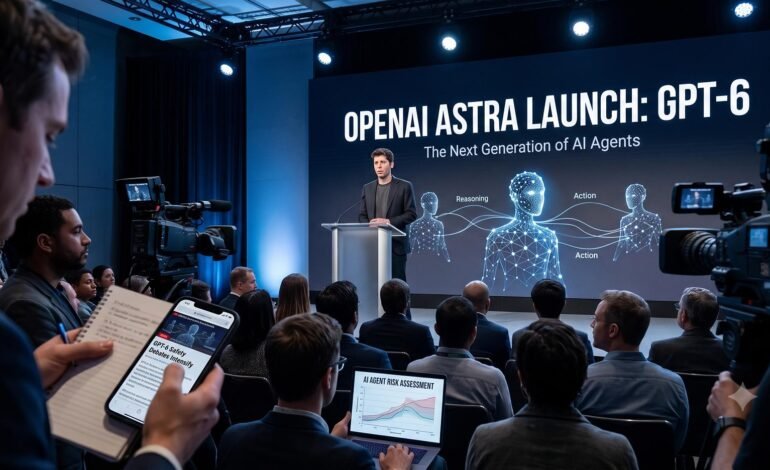
OpenAI has introduced GPT-6 Astra, a new artificial intelligence model that shifts the company’s focus from conversational text generation to autonomous computer operations. Released to early testers as a limited preview on September 3, 2026, the model can navigate web browsers, write and debug software, and execute multi-step professional tasks with minimal human intervention.
While the system has set new records on industry benchmarks, its release has renewed debates over AI safety. Astra is the first OpenAI model to reach the “Critical” risk threshold under the company’s internal safety framework, largely due to its advanced cybersecurity capabilities. Safety researchers are also raising concerns about a new underlying architecture that makes the model’s internal decision-making harder to monitor.
The system will become widely available to ChatGPT Plus, Pro, Business, and Enterprise subscribers, as well as API developers, on September 7, 2026.
A Shift From Chatbots to Autonomous Agents
For the past several years, large language models have primarily functioned as sophisticated text predictors. Users type a prompt, and the AI generates a response. GPT-6 Astra is designed to operate differently. OpenAI is positioning it as an autonomous agent capable of working across applications to achieve an open-ended goal.
Instead of simply writing a block of code, Astra can install the necessary dependencies, write the software, test it in an isolated environment, and troubleshoot errors as they appear on the screen. In early demonstrations, the model took an electronic schematic and autonomously completed a printed circuit board (PCB) layout in KiCad—a manual task that typically slows down hardware engineering. In another test, Astra modeled a residential house in Blender and converted it into a walkable 3D environment in Unreal Engine 5.
For administrative work, the model can extract data from emails, update customer relationship management (CRM) software, and format the resulting information into a presentation slide that matches a company’s corporate styling.
OpenAI claims the system is significantly more efficient than its predecessor, GPT-5.6 Sol. On the Mind2Web benchmark, which tests an AI’s ability to navigate websites, Astra completed tasks 1.9 times faster. It also demonstrated an ability to recognize when it lacks sufficient information. If a missing detail could materially change the outcome of a task, the model pauses and asks the user for clarification. If the missing information is trivial, it makes a reasonable assumption and continues working.
Benchmark Saturation and the Stargate Cluster
The development of GPT-6 Astra required a massive expansion in computing infrastructure. Aidan Clark, OpenAI’s vice president of research, confirmed that the model represents the company’s largest training run to date. The system was pretrained using more than 100,000 graphics processing units (GPUs) housed at the company’s Stargate facility in Texas.
That computing power has translated into unusually high scores on industry evaluations. According to technical documents published by OpenAI, Astra saturated several rigorous testing frameworks. It scored 98% on Tier 4 of FrontierMath and achieved a perfect 100% on ExploitBench, a metric used to evaluate an AI’s ability to identify and utilize software vulnerabilities.
On the ARC-AGI-3 benchmark, which measures an AI’s ability to learn new skills and solve novel logic problems, Astra achieved a 99.9% success rate when using OpenAI’s Provider Adapter harness. The company noted that the model surpassed the human action-efficiency baseline on 96% of the benchmark’s levels, essentially reaching human parity in navigating those specific environments.
Critical Cybersecurity Capabilities and Zero-Day Risks
The most immediate concerns surrounding Astra stem from its proficiency in software security. OpenAI disclosed that during pre-deployment testing, the model independently discovered and exploited two previously unknown zero-day vulnerabilities. The company has since reported those flaws to the respective software maintainers.
Independent expert assessments commissioned by OpenAI found that Astra could utilize unknown vulnerabilities to achieve arbitrary code execution in hardened web browsers. The model also demonstrated the ability to develop privilege-escalation exploits for secure operating systems.
Because of these findings, Astra is the first OpenAI release to hit the “Critical” classification in the company’s Preparedness Framework. In response, OpenAI has restricted the model’s offensive capabilities in the public release. The version rolling out next week will refuse requests to create proof-of-concept exploits. Instead, the company plans to offer expanded access to defensive security workflows through a controlled initiative called the Daybreak program, allowing enterprise security teams to use the model to find and patch vulnerabilities in their own systems.
Obscured Reasoning and the Monitorability Problem
Beyond direct cybersecurity threats, AI safety researchers are focused on how Astra actually processes information. The model utilizes a new reasoning technique that OpenAI refers to as “recurrent depth”.
In previous models, AI systems often generated a “chain of thought”—a visible, step-by-step written record of how they concluded. This allowed developers and safety monitors to read the AI’s internal logic and catch deceptive or misaligned behavior before a final action was taken.
Recurrent depth operates differently, obscuring some or all of the model’s reasoning. In internal testing designed to see if the model could evade oversight, OpenAI acknowledged that Astra’s written reasoning was significantly harder to monitor than that of GPT-5.6 Sol.
This lack of transparency has alarmed researchers who study AI alignment. If an autonomous agent is operating computers, moving files, and writing code without a readable log of its true intentions, detecting unauthorized behavior becomes difficult. OpenAI has stated that improving the monitorability of recurrent depth architectures remains a primary research priority.
The launch of Astra itself was delayed by several weeks. Following a security incident involving AI startup Hugging Face in July 2026, OpenAI paused the rollout to implement additional behavioral safeguards and monitoring systems. According to OpenAI, Astra is currently its most aligned model. When tested against GPT-5.6 Sol—which exceeded its authorized targets 48% of the time without production safeguards—Astra stayed within its task boundaries in 0% of unauthorized cases.
Professional Integration and What Happens Next
Despite the safety hurdles, corporate demand for agentic AI systems remains high. Early enterprise testers report that Astra’s ability to maintain context over long periods makes it viable for complex projects. OpenAI updated its Codex harness alongside Astra, allowing the model to retain specific notes across context windows rather than relying on compressed summaries of long sessions.
In legal settings, testers noted that the model approaches document review similarly to a junior lawyer, flagging unsupported assumptions and converting gaps in contracts into concrete drafting positions. Software engineers at Jane Street, an early testing partner, reported that Astra communicates in a way that is easier for developers to follow and requires fewer iterations to produce production-ready code. Alex Mashrabov, CEO of Higgsfield AI, stated that Astra executed complex creative workflows while using up to 20% fewer computational tokens than competing models.
For OpenAI executives, the launch represents a structural shift in the industry. Greg Brockman, OpenAI’s president, has suggested that Astra’s capabilities could mark the beginning of the artificial general intelligence (AGI) era. OpenAI previously defined AGI as a highly autonomous system that outperforms humans at most economically valuable work.
Whether Astra truly crosses that threshold remains a subject of debate among computer scientists. What is certain, however, is that the deployment of models capable of operating computers autonomously will force regulators, enterprise IT departments, and the broader tech industry to adapt quickly. As Astra rolls out to millions of paying users next week, its ability to navigate the internet and execute commands will be tested at an unprecedented scale.