China Challenges US AI Supremacy With Global Vision

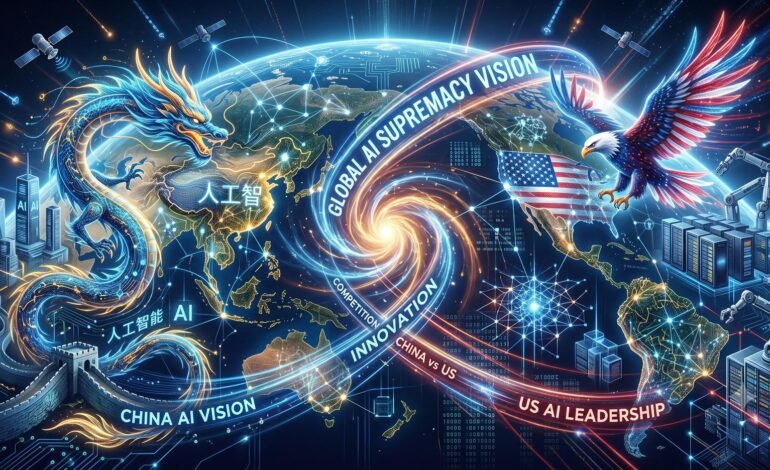
SHANGHAI — China has formally launched a concerted campaign to reshape the global administration of artificial intelligence, presenting its open-source technology ecosystem as a public good for developing nations. Speaking at the World Artificial Intelligence Conference (WAIC) in Shanghai in mid-July 2026, Chinese President Xi Jinping articulated a comprehensive vision for AI governance that directly challenges the current trajectory of United States technology policy.
The presentation marked a definitive escalation in the ongoing technology competition between the world’s two largest economies. By explicitly framing China as the champion of the Global South and emphasizing open access over restricted commercial models, Beijing is attempting to bypass U.S. export controls and build a parallel sphere of technological influence. This strategy relies on forming new multilateral institutions and heavily subsidizing international AI training, setting the stage for a fragmented global technology landscape.
Background
The global regulatory environment for artificial intelligence has grown increasingly fractured over the past two years. Washington has systematically tightened export controls on advanced semiconductors and the equipment necessary to manufacture them, aiming to restrict China’s ability to develop frontier AI models. Concurrently, the U.S. has advocated for frameworks that prioritize national security, pushing alliances that critics in Beijing characterize as exclusionary.
Earlier in 2026, the diplomatic divide became fully apparent at the United Nations. When the UN General Assembly voted in February to establish an independent international scientific panel on AI, the U.S. was one of only two nations to vote against the measure, preferring to collaborate strictly with close allies. The U.S. government has also removed proprietary models developed by American firms from certain overseas markets, citing national security concerns.
In response, China has accelerated its domestic AI capabilities while positioning itself as a victim of American technological containment. Beijing has repeatedly criticized Washington for overstretching the concept of national security to suppress competition. This diplomatic groundwork culminated in the July 2026 WAIC, which served as the launchpad for China’s institutional counter-offensive.
Key Developments
The centerpiece of China’s new strategy is the creation of the World Artificial Intelligence Cooperation Organisation (WAICO). Formally established during the Shanghai conference, the non-governmental organization launched with 29 founding member nations, including Brazil, Kazakhstan, Pakistan, Russia, Laos, and Indonesia. Xi described the bloc as a direct response to demands from the Global South for a more equitable distribution of technology.
To support this institutional framework, the Chinese government announced tangible resource commitments. Over the next five years, China will fund 5,000 AI training and seminar opportunities specifically designated for developing nations. Furthermore, Beijing plans to establish localized AI application cooperation centers in partnership with the Association of Southeast Asian Nations (ASEAN), the African Union, BRICS members, and Latin American countries.
Simultaneously, Chinese domestic technology companies used the WAIC platform to demonstrate their progress despite U.S. sanctions. Beijing-based startup Moonshot AI revealed Kimi K3, which the company claims is the world’s largest open AI model determined by parameter count. The product launch was strategically timed to contrast with the restricted access policies governing American proprietary models.
Xi also addressed the physical safety of AI systems, urging the international community to establish early-warning and emergency-response protocols to prevent scenarios where autonomous software could evade human oversight. He insisted that all AI development must remain strictly under human control.
Why It Matters
The emergence of WAICO and China’s open-source diplomacy represents a structural shift in international relations. Artificial intelligence is no longer viewed merely as a commercial product; it is foundational infrastructure that will determine future economic productivity and military capability.
For nations outside the immediate U.S. alliance network, the Chinese proposition offers an attractive alternative. Developing countries frequently lack the capital and infrastructure to build indigenous frontier models. By offering open-source alternatives and subsidized training, China is integrating these emerging economies into its technological ecosystem. Once a nation builds its digital infrastructure upon Chinese platforms and standards, transitioning to Western alternatives becomes technically difficult and financially prohibitive.
This dynamic creates a stark contrast with the U.S. approach. Prominent figures in the American technology sector, including Google DeepMind CEO Demis Hassabis, have recently advocated for a U.S.-led international AI safety agency. Washington’s strategy heavily emphasizes the protection of intellectual property and the containment of potential adversaries through alliances. Beijing is attempting to counter this by framing the American strategy as a mechanism to maintain a global monopoly and perpetuate historical injustices.
Industry Perspective
Technology analysts note that China’s emphasis on open-source solutions is a pragmatic response to its geopolitical position. Unable to freely access the most advanced hardware components due to U.S. trade restrictions, Chinese firms have optimized their software to run efficiently on less powerful, more readily available infrastructure.
George Chen, Chair in Digital Practice at The Asia Group, stated that the message from Shanghai was unequivocal. “China is not going to follow anyone on both AI technology and standards. Instead, China is going to lead the world in both aspects,” Chen observed. He added that the announcements served as a clear warning that Beijing will reject external dictates regarding its technology sector.
For corporate entities operating under international sanctions, the Chinese ecosystem provides a vital lifeline. Representatives from Sberbank, Russia’s largest financial institution and a target of comprehensive U.S. sanctions, attended the WAIC to evaluate Chinese AI models and humanoid robotics. The bank currently relies heavily on Chinese technology components to maintain its operations. This growing reliance among sanctioned entities demonstrates how U.S. restrictions have inadvertently accelerated the creation of a parallel technology market centered in Beijing.
Market or Consumer Impact
The commercial implications of this geopolitical division are substantial. Chinese technology companies are aggressively marketing their AI solutions as cost-effective alternatives to Western products. By promoting open-source software, Beijing lowers the barrier to entry for developers and enterprises in emerging markets.
This strategy places immediate pressure on U.S. software vendors operating internationally. While American proprietary models may hold a performance advantage in specific, highly complex tasks, Chinese open-source alternatives are often sufficient for standard commercial applications. For a telecommunications firm in Southeast Asia or a logistics company in Latin America, the combination of lower costs, open access, and Chinese state-backed training programs presents a compelling business case.
Furthermore, this division forces multinational corporations to navigate an increasingly complex compliance environment. Hardware manufacturers and software developers must now ensure their products integrate with distinct regulatory standards across different jurisdictions. The fragmentation of AI governance threatens to increase operational costs and complicate international data sharing agreements.
Future Outlook
The trajectory of global AI administration will face several critical tests in the near term. Washington and Beijing are preparing for their first government-level dialogues on artificial intelligence under the new U.S. administration. These discussions will serve as an initial indicator of whether the two nations can establish baseline communication protocols or if the sector will fully bifurcate into competing spheres.
The United States continues to invest heavily in maintaining its technological lead. A bipartisan package of legislation is currently advancing through the U.S. House of Representatives, designed to expand researcher access to advanced computing resources, increase security, and improve federal data availability for AI applications. U.S. lawmakers argue that removing domestic barriers to innovation is the most effective method to counter Chinese state subsidies.
However, the rapid expansion of WAICO indicates that a significant portion of the international community is receptive to Beijing’s overtures. If China successfully executes its promise to deliver 5,000 training programs and establish regional cooperation centers, it will cement its influence over the next generation of software engineers and policymakers across the Global South.
Conclusion
China’s announcements at the 2026 World Artificial Intelligence Conference represent a mature, highly coordinated strategy to challenge U.S. dominance in the defining technology of the current era. By organizing a 29-nation coalition and offering concrete resources to developing economies, Beijing is shifting the debate from technical capability to global equity. As the United States focuses on security and containment, China is utilizing open-source access as an instrument of foreign policy. The resulting competition will dictate not only the commercial future of the technology sector but also the structural framework of international relations for decades to come.
10 FAQs
Q1: What is the World Artificial Intelligence Cooperation Organisation (WAICO)?
A: WAICO is an international non-governmental organization launched in July 2026 in Shanghai. It consists of 29 founding member countries and was established by China to promote global AI collaboration, specifically addressing the needs of developing nations.
Q2: How is China’s approach to AI governance different from the United States?
A: China advocates for open-source AI as a global public good, emphasizing equitable access for the Global South. The U.S. approach currently prioritizes national security, proprietary technology protection, and alliances with closely aligned nations to control the supply chain.
Q3: What did President Xi Jinping promise developing countries regarding AI?
A: President Xi committed to providing developing countries with 5,000 opportunities in AI training and seminar programs over the next five years. He also announced plans to build AI application cooperation centers with regional blocs like ASEAN and BRICS.
Q4: Why did the U.S. vote against the UN AI scientific panel?
A: In early 2026, the U.S. voted against establishing a UN independent international scientific panel on AI, indicating a preference for collaborating with a smaller, curated group of allied nations rather than relying on broad UN mandates.
Q5: What is Kimi K3?
A: Kimi K3 is an open AI model developed by Beijing-based startup Moonshot AI. Unveiled at the 2026 WAIC, the company claims it is the world’s largest open AI model based on parameter count.
Q6: Are Chinese AI models available outside of China?
A: Yes. Chinese firms actively export their AI hardware and software globally. They market these products as cost-effective, open-source alternatives to American technology, particularly targeting emerging markets.
Q7: How do U.S. export controls affect global AI development?
A: U.S. export controls restrict the sale of advanced semiconductors and manufacturing equipment to certain countries. This policy forces nations unable to access American components to seek alternative suppliers, primarily accelerating the adoption of Chinese technology.
Q8: What is China’s stance on AI safety and autonomous systems?
A: During the WAIC, President Xi stated that AI systems must remain under strict human control. He called for urgent international protocols for early-warning and emergency-response mechanisms to prevent software from evading human oversight.
Q9: Who attended the WAIC 2026 in Shanghai?
A: The conference hosted Chinese technology executives, international government officials, and representatives from sanctioned entities like Russia’s Sberbank. High-profile attendees included UN Secretary-General Antonio Guterres and Kazakh President Kassym-Jomart Tokayev.
Q10: Will the U.S. and China negotiate on AI rules?
A: Washington and Beijing are preparing for government-level AI dialogues. However, given their fundamentally opposing strategies regarding open-source access versus security controls, establishing common regulatory ground remains highly challenging.