NVIDIA RTX 6090: First Specs Leaked in Next-Gen AI GPU Race

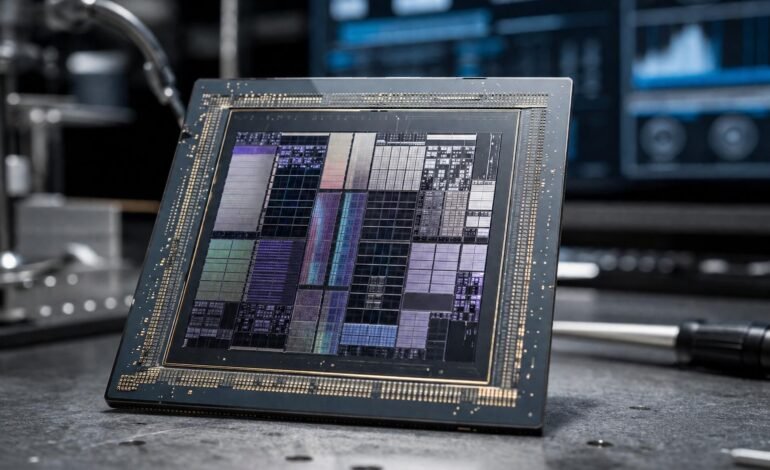
NVIDIA is preparing the foundation for its next generation of consumer and enterprise graphics processors, internally designated as the Rubin architecture. Early specifications surrounding the flagship RTX 6090 suggest a deliberate shift in how the semiconductor manufacturer allocates silicon resources. The company is prioritizing memory bandwidth and dedicated tensor performance to support a rising class of agentic AI workloads and path-traced rendering.
According to preliminary supply chain leaks and hardware documentation circulating among system integrators, the RTX 6090 will utilize a customized 3-nanometer manufacturing process from Taiwan Semiconductor Manufacturing Company (TSMC). The silicon, reportedly carrying the codename GR202, represents the top tier of NVIDIA’s upcoming consumer portfolio.
The transition from the current Blackwell architecture to Rubin highlights a broader industry realignment. Hardware is no longer scaling purely through higher clock speeds; instead, architectural co-optimization and wider memory buses are driving generation-over-generation performance gains.
Background: The Blackwell Precedent
To understand the trajectory of the RTX 60-series, it is necessary to examine the current hardware landscape. In January 2025, NVIDIA released the RTX 5090, cementing the Blackwell architecture as the dominant force in both enterprise data centers and enthusiast computing. The RTX 5090 featured the GB202 processor, delivering 32GB of GDDR7 memory operating on a 512-bit bus. The hardware established a standard for local language model execution and high-fidelity rendering, carrying a launch price of $1,999.
Eighteen months later, the competitive and technological landscape has shifted. The deployment of generative AI has moved from simple chat interfaces to autonomous, multi-step agentic systems. These workloads require persistent memory and continuous, low-latency reasoning loops. Consumer hardware is increasingly evaluated by its capability to run localized AI infrastructure rather than strictly rasterized rendering performance.
NVIDIA’s product cadence historically dictates a two-year gap between major consumer architectural releases. This timeline positions the RTX 60-series for an early 2027 debut. The intervening period is typically characterized by supply chain verifications, partner board designs, and initial silicon tape-outs, which are currently generating the initial wave of technical disclosures.
Key Developments: Inside the GR202 Silicon
The core of the RTX 6090 centers on the GR202 processor. Current supply chain data indicates the chip will feature up to 192 Stream Multiprocessor (SM) units. Compared to the RTX 5090, which utilizes 170 SMs, this represents an approximate 12.9 percent increase in raw execution units.
However, the primary performance multipliers are expected to come from redesigned tensor and ray-tracing cores. The Rubin architecture reportedly integrates sixth-generation Tensor cores and fifth-generation Ray Tracing (RT) units. Engineering targets point toward a doubling of path-tracing performance compared to the Blackwell generation, alongside a 30 to 35 percent improvement in traditional rasterization.
Memory configuration remains a critical bottleneck for local computing. The RTX 6090 is slated to retain a 512-bit memory bus and 32GB of GDDR7 VRAM. While enterprise variants of the Rubin architecture are transitioning to HBM4 (High Bandwidth Memory) to manage massive datasets, cost constraints dictate that the consumer desktop market will continue utilizing GDDR standards.
The manufacturing process itself is a tailored variant of TSMC’s 3nm FinFET node. Previous speculation suggested NVIDIA might accelerate its roadmap to adopt a sub-2nm process, but the company has chosen the maturity and yield stability of the 3nm platform. This decision reduces production risks while allowing engineers to extract efficiency gains through architectural refinements.
Below the flagship model, early documentation suggests the RTX 6080 (GR203) will feature a 320-bit memory bus with 20GB of VRAM. The RTX 6070 (GR205) will likely carry a 256-bit bus and 16GB of VRAM, addressing long-standing criticisms regarding memory capacity in mid-tier graphics cards.
Why It Matters: Agentic AI and Deprecating Rasterization
The specifications of the RTX 6090 signal a departure from traditional rasterization-first design philosophies. For over a decade, graphics cards were optimized to push polygons and apply shaders as quickly as possible. Today, the compute focus is split between upscaling algorithms, frame generation, and local machine learning execution.
The inclusion of sixth-generation Tensor cores indicates NVIDIA is preparing the hardware foundation for DLSS 5 (Deep Learning Super Sampling) and advanced AI frameworks. The capacity to run large language models or mixture-of-experts (MoE) systems locally depends entirely on memory capacity and bandwidth. By maintaining a 512-bit bus and implementing faster iterations of GDDR7, NVIDIA is providing local infrastructure for developers to build applications that do not rely on cloud processing.
Furthermore, the enterprise side of the Rubin architecture introduces the Vera CPU, suggesting NVIDIA is building a more cohesive hardware ecosystem where the central processor and graphics processor share memory pools and execution tasks. While the RTX 6090 remains a discrete PCIe component, the architectural principles derived from the Vera and Rubin server racks will influence how the desktop GPU manages data internally.
Industry Perspective
Analysts tracking the semiconductor sector note that NVIDIA’s primary challenge is not performance, but market segmentation. The extreme demand for compute hardware allows the company to price enterprise accelerators at significant premiums, placing the consumer market in a complicated position.
The desktop GPU market operates as a byproduct of enterprise AI development. The GR202 silicon is essentially a highly binned, consumer-packaged version of the technology driving hyperscale data centers. The primary concern for the consumer market is how much of that enterprise capability NVIDIA will unlock at a consumer price point without cannibalizing its workstation sales.
Software developers are adjusting their roadmaps based on these hardware signals. With path tracing becoming computationally viable on a broader range of hardware, game engines are beginning to deprecate traditional rasterized lighting systems entirely. The anticipated ray-tracing performance in the RTX 60-series provides the necessary overhead to make fully path-traced environments standard in high-end software development.
Market and Consumer Impact
For the consumer market, the RTX 6090 represents a continuation of the ultra-premium hardware tier. The RTX 5090 established a $1,999 baseline, and given ongoing constraints in semiconductor manufacturing and high memory costs, the next generation is unlikely to see a price reduction. Market expectations currently place the RTX 6090 at or above the $2,000 threshold.
Power consumption is another metric drawing scrutiny. The RTX 5090 operates with a 575W Total Graphics Power (TGP) rating. While the transition to a 3nm process provides efficiency gains, NVIDIA has historically utilized thermal headroom to maximize absolute performance rather than reducing power draw. System builders anticipate the RTX 6090 will maintain similar power requirements, necessitating robust 12V-2×6 connectors and power supplies exceeding 1000 watts.
The broader impact will be felt in the workstation and prosumer segments. Small-to-medium studios and independent AI researchers rely on xx90-class hardware as a cost-effective alternative to enterprise server leasing. A 32GB framebuffer connected to a 512-bit bus allows researchers to fine-tune models with tens of billions of parameters locally, bypassing the recurring costs of cloud compute platforms.
Future Outlook
Looking toward 2027, the GPU market will test the limits of monolithic silicon design. The GR202 die is expected to push the boundaries of TSMC’s reticle limits.
Competitors are pursuing alternative strategies. AMD has aggressively adopted chiplet designs, disaggregating the GPU into smaller, easier-to-manufacture compute tiles. NVIDIA has resisted this approach for its consumer graphics cards, citing the latency penalties associated with chiplet interconnects. The RTX 60-series may represent the final generation where a monolithic design is economically viable for high-end consumer hardware.
Additionally, the integration of autonomous AI agents into operating systems requires hardware that is constantly active, interpreting context, and executing tasks in the background. The architectural choices made in the Rubin generation will dictate how efficiently these background processes run without degrading active application performance.
Conclusion
The NVIDIA RTX 6090 and the broader Rubin architecture arrive at a critical juncture for personal computing. Hardware specifications are no longer defined solely by display resolution capabilities, but by the ability to act as a local node for complex AI processing.
While official announcements are likely months away, the leaked parameters of the GR202 silicon—192 SMs, 32GB of GDDR7, and a custom 3nm process—outline a product designed to maintain NVIDIA’s dominance in both high-end rendering and desktop machine learning. As the industry moves closer to 2027, the focus will shift from hardware validation to the software ecosystems capable of utilizing this scale of compute.
Frequently Asked Questions
What is the expected release date for the NVIDIA RTX 6090?
Based on NVIDIA’s standard two-year release cadence, the RTX 6090 is anticipated to launch in early 2027.
What architecture will the RTX 60-series use?
The RTX 60-series will utilize the Rubin architecture, succeeding the current Blackwell generation.
How much memory will the RTX 6090 have?
Early leaks indicate the RTX 6090 will feature 32GB of GDDR7 memory on a 512-bit memory bus.
Will the RTX 6090 use TSMC’s 2nm process?
No, current information suggests the RTX 60-series will utilize a custom variant of TSMC’s 3nm FinFET process rather than moving to a sub-2nm node.
How does the RTX 6090’s core count compare to the RTX 5090?
The RTX 6090 is rumored to feature up to 192 Stream Multiprocessors (SMs), an increase from the 170 SMs found in the RTX 5090.
What improvements are expected for ray tracing?
The Rubin architecture reportedly includes fifth-generation Ray Tracing (RT) cores, with engineering targets aiming to double the path-tracing performance of the previous generation.
How will the RTX 6090 impact local AI development?
With sixth-generation Tensor cores and substantial memory bandwidth, the GPU is positioned to handle complex, local agentic AI workloads and mixture-of-experts models without relying on cloud compute.
What is the projected price for the RTX 6090?
While pricing is not confirmed, industry analysts expect it to remain at or above the $1,999 baseline established by the RTX 5090 due to high manufacturing and memory costs.
Will the RTX 60-series use a chiplet design?
Information regarding the consumer RTX 60-series indicates NVIDIA will maintain a monolithic silicon design, despite competitors shifting toward chiplet architectures.
What power supply will be required for the RTX 6090?
Given the high performance targets and the 575W power rating of the predecessor, system builders recommend power supplies exceeding 1000 watts, utilizing modern 12V-2×6 connectors.