Tesla, Alphabet Shares Drop as AI Capital Expenditure Surges

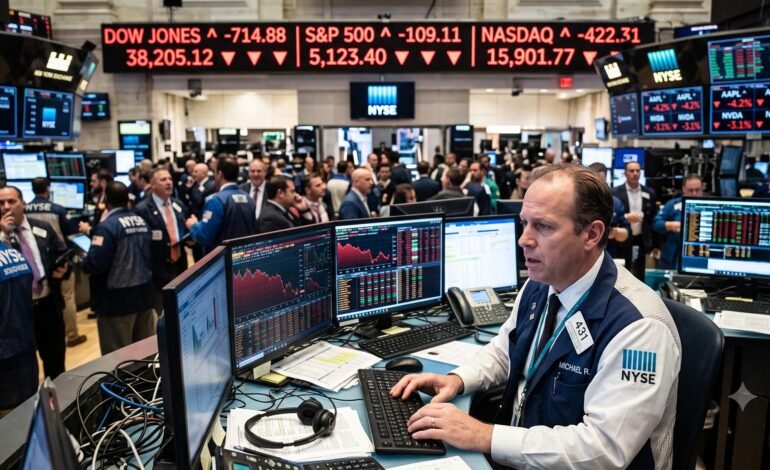
Wall Street is beginning to question the price tag of the artificial intelligence boom.
Shares of Alphabet and Tesla fell sharply on Thursday after their second-quarter earnings reports revealed massive spending on AI infrastructure. Both companies posted strong top-line revenue, but investors focused instead on shrinking profit margins, cash burn, and the billions of dollars flowing out the door to fund data centers and advanced hardware.
The market reaction signals a notable shift in sentiment. For nearly two years, investors rewarded companies that announced massive capital commitments to new technology. Now, they are demanding clear timelines on when those hardware purchases will translate into actual profits.
Alphabet, Google’s parent company, saw its stock decline by roughly 7% despite beating Wall Street’s revenue estimates. Tesla faced a steeper drop, with its stock plunging 14% to around $319 after the electric vehicle manufacturer reported its first quarterly cash burn in two years.
The sell-off dragged the broader market down with it. The Nasdaq Composite fell 2.2%, while the S&P 500 dropped 1.55%.
Alphabet’s Expanding Server Bill
Alphabet’s core business remains highly profitable, but the sheer scale of its capital expenditure caught investors off guard.
The company reported second-quarter revenue of $119.8 billion, a 24% increase from the same period last year. Its Google Cloud division proved to be a primary growth driver, with revenue surging 82% to $24.8 billion. That easily surpassed analyst expectations of $22.4 billion.
Yet the focus on the earnings call quickly shifted to the cost of maintaining that growth. Alphabet raised its capital expenditure guidance for 2026 to a range of $195 billion to $205 billion. This marks a significant jump from its previous estimate of $180 billion to $190 billion.
During the second quarter alone, Alphabet spent $44.9 billion on capital expenditures. That figure is nearly double what the company spent during the same quarter last year.
Alphabet Chief Executive Sundar Pichai defended the spending. He told analysts the increase is required to build enough computing capacity to meet rapidly expanding consumer and enterprise demand.
“The spending increase is primarily due to an acceleration in the delivery of capacity to meet growing demand,” Pichai said.
Chief Financial Officer Anay Ashkanazi provided a breakdown of the costs. About 60% of the quarter’s capital expenditures went directly toward purchasing servers. The remaining 40% funded the construction of new data centers and related physical infrastructure.
Despite the heavy spending, analysts noted that Alphabet’s cloud margins are still expanding. Cantor Fitzgerald lowered its price target for Alphabet stock from $435 to $420 but kept an overweight rating. Raymond James also slightly trimmed its target to $400 while maintaining a strong buy rating, noting that the firm will now closely watch the performance of Google’s Gemini 4 model.
Tesla Falls on Margin Pressures
While Alphabet managed to expand its operating margin to 34%, Tesla went in the opposite direction.
The automaker’s shares tumbled after reporting adjusted earnings of 33 cents per share. This fell well short of the 50 cents Wall Street expected. The earnings miss occurred even as Tesla posted a record 480,126 vehicle deliveries for the quarter.
Tesla’s overall revenue rose 25.5% year-on-year to $28.24 billion. Automotive sales hit $20.01 billion, while the company’s energy generation and storage business saw revenue increase 13% to $3.14 billion.
The problem for investors was profitability. Operating expenses surged 47% to $4.35 billion. Management attributed the jump to heavy investments in software projects, the upcoming Cybercab, the Optimus humanoid robot, and the Tesla Semi.
Tesla’s capital expenditure surged 142% year-on-year, hitting $5.79 billion for the quarter. The heavy spending resulted in a negative free cash flow of $1.09 billion. This marks Tesla’s first quarter of cash burn in two years.
Operating income fell 57% to $398 million, causing the company’s operating margin to collapse to 1.4%. A year earlier, that margin stood at 4.1%.
Chief Executive Elon Musk attempted to reassure investors during the company’s earnings call, framing the high costs as a necessary foundation for future product lines.
“This is a massive capex year,” Musk said on Wednesday. “I’m confident that all the things that we’re investing in will yield incredible returns. Really, maybe the best capex returns that we’ve ever seen.”
Despite the poor margins, Tesla did report positive momentum in its software and energy divisions. Active subscriptions for its Full Self-Driving (FSD) software rose 56% to 1.48 million users. The company noted that more than 55% of North American deliveries included an FSD subscription at the time of purchase. Energy storage deployments also jumped 41% to 13.5 GWh.
The Tech Sector Faces a Reality Check
The market reaction to Alphabet and Tesla highlights a growing tension on Wall Street. Technology companies are locked in an expensive arms race to build out computing infrastructure. They argue that falling behind in hardware capacity poses an existential threat to their core businesses.
Investors are looking at the math differently. They see massive cash outflows and want to know how quickly these new data centers will generate tangible revenue.
Analysts estimate that the four largest tech companies—Alphabet, Meta, Microsoft, and Amazon—could spend up to $725 billion collectively this year just to expand their infrastructure.
Daniel Skelly, head of Morgan Stanley’s Wealth Management Market Research and Strategy Team, told Reuters that markets were already dealing with a correction in semiconductor stocks. Now, they are grappling with the reality of just how much capital the largest technology firms intend to spend.
Skelly noted that while the long-term drivers for the sector remain intact, volatility is likely to continue until these companies can prove their infrastructure investments will translate into sustained earnings growth.
Global Spillover
The sell-off in U.S. markets had immediate consequences globally.
Asian technology stocks took a heavy hit on Friday. South Korea’s benchmark KOSPI index dropped as much as 6.2%. Semiconductor companies bore the brunt of the selling, as they are the primary beneficiaries of U.S. data center spending. Shares of memory chip giant SK Hynix and Samsung Electronics both fell more than 7%.
Taiwan’s benchmark index also dropped nearly 2.7%.
In India, information technology stocks mirrored the U.S. decline. The Nifty IT index fell, with major outsourcing firms like Infosys and Tech Mahindra dropping as global investors pulled back from the broader technology sector.
The sharp drop in semiconductor and hardware stocks suggests investors are re-evaluating the entire supply chain. If Wall Street forces U.S. technology companies to scale back their spending plans to protect profit margins, the hardware suppliers in Asia will see their revenue forecasts drop.
What Happens Next
The focus now turns to the rest of the technology sector.
Alphabet and Tesla were the first of the massive technology firms to report earnings this season. Microsoft, Meta Platforms, and Amazon are scheduled to announce their results next week.
Investors will be scrutinizing their cash flow statements and capital expenditure guidance. Meta shares already slipped 3% in sympathy following Alphabet’s report, as traders brace for potentially similar spending forecasts.
If Microsoft and Amazon report equally high infrastructure costs without showing proportional near-term revenue gains, the current market correction could deepen. A company’s willingness to spend heavily on servers is no longer enough to satisfy shareholders. They now expect clear timelines for profitability.