Motorola’s Foldable Smartwatch Concept: Are Wearables the Next Smartphone?

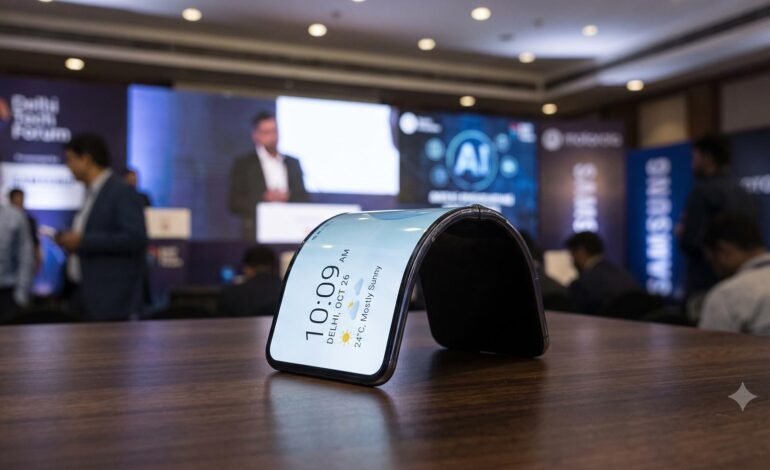
A newly granted Motorola patent describes a wearable device with a flexible display that unwraps into a handheld screen. The concept builds on years of experimental hardware designs aimed at bridging the gap between smartwatches and traditional phones.
Motorola is continuing to experiment with devices that blur the physical boundaries between smartphones and smartwatches. A newly awarded patent details a wearable concept that starts as a wrist-bound watch and unfolds into a larger, handheld display. This approach reverses the company’s previous flexible device demonstrations, suggesting a persistent engineering focus on transforming wrist-worn computing.
The technology industry has spent more than a decade trying to balance the portability of wearables with the utility of larger screens. While smartwatches excel at biometric tracking and passive notifications, their small displays inherently restrict complex interactions. Motorola’s latest intellectual property filing suggests the company believes hardware flexibility, rather than just software efficiency, is the solution.
The Patent: A Watch That Becomes a Screen
The patent, officially registered as US12,693,705 and titled “Pivoting wearable reconfigurable screen,” was granted to Motorola in late July. It outlines a device where the watch strap itself acts as a continuous flexible screen.
When worn on the wrist, the device functions as a standard smartwatch. However, once removed, the strap can pivot on a hinge mechanism. This allows the two sections of the band to align alongside each other, locking together via magnetic or mechanical interlocking components. The resulting configuration is a short, wide display similar to a compact smartphone.
According to the filing, built-in sensors would detect the device’s physical configuration and automatically adjust the software interface. In its wrist-worn state, the user interface would prioritize standard wearable tasks like fitness tracking, quick replies, and notifications. When flattened and locked into its wider configuration, the interface would expand to accommodate full applications, media viewing, and a standard touch keyboard.
Reversing the Adaptive Display Concept
This latest patent marks a distinct pivot from Motorola’s earlier experiments with flexible wrist devices. At Lenovo Tech World in October 2023 and the Mobile World Congress (MWC) in February 2024, the company demonstrated an “Adaptive Display” concept.
That prototype took the opposite approach: it was a standard 6.9-inch pOLED smartphone that bent backward to wrap around the user’s wrist. To achieve this, Motorola engineers crafted a backplate from woven fabric that housed numerous tiny batteries linked in a chain-like formation, allowing the device to flex at multiple hinge points mimicking the human spine. Users attached it to their arms using a magnetic band reminiscent of a Milanese loop.
While the MWC prototype drew significant attention from attendees, the practical limitations of wrapping a full-sized phone around a wrist were immediately apparent. The device was bulky, the beta hardware exhibited occasional input recognition failures, and properly aligning the magnetic pins required a collaborative effort.
The new patent approaches the form factor dilemma from the opposite direction. Rather than a full-sized phone that awkwardly bends to fit the wrist, the device is primarily a watch that expands into a larger screen only when necessary.
The Historical Context of Wrist Computing
The ambition to place a fully functional computer on the wrist is not new. Early digital calculator watches in the 1980s laid the groundwork for miniaturized hardware. Later, devices like the Pebble smartwatch proved that consumers wanted wrist-based notification centers. However, as mobile operating systems matured, the screen size emerged as a permanent bottleneck. A display small enough to wear comfortably is too small for sustained typing, reading, or media consumption.
Previous attempts to solve this limitation via hardware have seen limited commercial success. In 2018, Nubia introduced the Alpha, a device that wrapped a 4.01-inch OLED display around the upper wrist. It offered more screen space than a traditional watch and could handle voice calls and basic applications. However, the display was rigidly curved and remained a watch—it could not physically transform or flatten into a more conventional format. It proved that consumers were curious about wraparound displays, but the static form factor restricted its utility.
Technical Hurdles: Durability and Battery Architecture
Motorola’s proposed design faces substantial engineering obstacles before it can move from a patent filing to consumer hardware. Flexible OLED panels remain vulnerable to repeated mechanical stress. A device designed to be bent, pivoted, and snapped together multiple times a day would require a highly durable screen and a resilient hinge mechanism that avoids creasing or dead pixels.
Power distribution presents an equally complex challenge. Traditional smartphones rely on a single, large lithium-ion battery housed behind a flat screen. A pivoting, flexible strap requires power sources distributed throughout the band. While Motorola utilized segmented batteries in its MWC concept phone, routing power and data connections across moving joints without compromising safety, battery capacity, or device thickness remains one of the hardest problems in flexible electronics.
Furthermore, smartwatches are exposed to environmental hazards—water, sweat, dust, and constant physical impacts—at a much higher rate than smartphones. Sealing a transforming device with exposed hinges against water and dust ingress would be a significant manufacturing achievement.
The Market Strategy: Iteration vs. Experimentation
Motorola’s approach contrasts sharply with the strategies of market leaders Apple and Samsung. Both companies maintain strict physical boundaries between their phone and wearable divisions.
Apple and Samsung have positioned their flagship wearables, the Apple Watch and Galaxy Watch, as companion devices focused heavily on health diagnostics, fitness tracking, and tight ecosystem integration. Rather than fundamentally altering the hardware shape, both companies have expanded capabilities by iterating on processors, adding advanced biometric sensors, and increasing battery life. Their latest high-end models—the Apple Watch Ultra and the Galaxy Watch Ultra—offer larger screens and rugged titanium chassis, but they remain traditional, static watches.
By exploring transforming hardware, Motorola—backed by the manufacturing and research resources of its parent company, Lenovo—is testing whether consumers actually want a single device to serve both functions. While Apple and Samsung dominate the premium sector through careful, iterative refinement, Motorola is attempting to carve out a niche in experimental form factors. This aggressive experimental strategy previously yielded the successful revival of the Motorola Razr as a modern foldable, proving the company is willing to bring conceptual hinge designs to the mass market.
What Happens Next
Technology companies file thousands of patents annually, and a granted patent does not guarantee a commercial release. The “Pivoting wearable reconfigurable screen” is currently a conceptual framework rather than a confirmed product roadmap.
However, Motorola’s continued investment in flexible display patents and functional prototypes indicates the company views the convergence of wearables and smartphones as a viable hardware category. As foldable technology matures and the manufacturing costs for flexible panels and micro-hinges decrease, the industry will eventually have the capability to test whether the public is ready for a watch that unfolds into a phone.
Until that engineering threshold is crossed, the divide between the wrist and the pocket remains intact.